In the maritime industry, laundry operations are not just about maintaining hygiene; they play a critical role in crew welfare and operational continuity. The Maritime Labour Convention (MLC 2006) mandates that shipowners provide adequate and accessible laundry facilities for the crew. From the boutique needs of a private yacht to the industrial-scale requirements of a massive cruise ship, every system must be built upon high-performance marine laundry equipment and an intelligent layout.
Regulatory Compliance: MLC 2006 and Crew Welfare
MLC 2006 standards aim to bring living conditions on board closer to those found on land. Within this framework, laundry systems must meet several core requirements:
-
Accessibility: Adequate capacity equipment must be provided so that crew members can wash their own clothes.
-
Hygiene and Sanitation: Laundries must be designed to prevent cross-contamination, keeping cleanliness standards at the highest level.
-
Sufficiency: The number of machines must be sufficient based on the total number of crew members and their working hours.
Capacity Calculation and Space Planning
A successful system installation begins with an accurate capacity estimation. Requirements vary significantly based on the type of vessel:
-
Commercial Ships: Systems typically focus on crew size, prioritizing durability and simple operation.
-
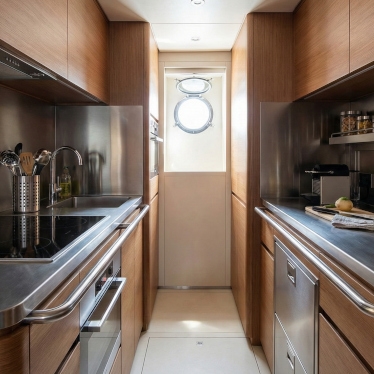
Yachts and Superyachts: Due to limited space, compact but high-performance machines are used, with a focus on the delicate care of guest linens.
-
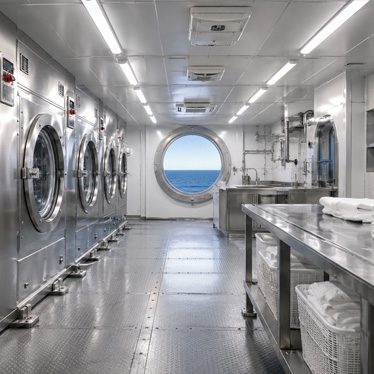
Cruise Ships: Full industrial lines are installed, operating 24/7 to process tons of textiles daily.
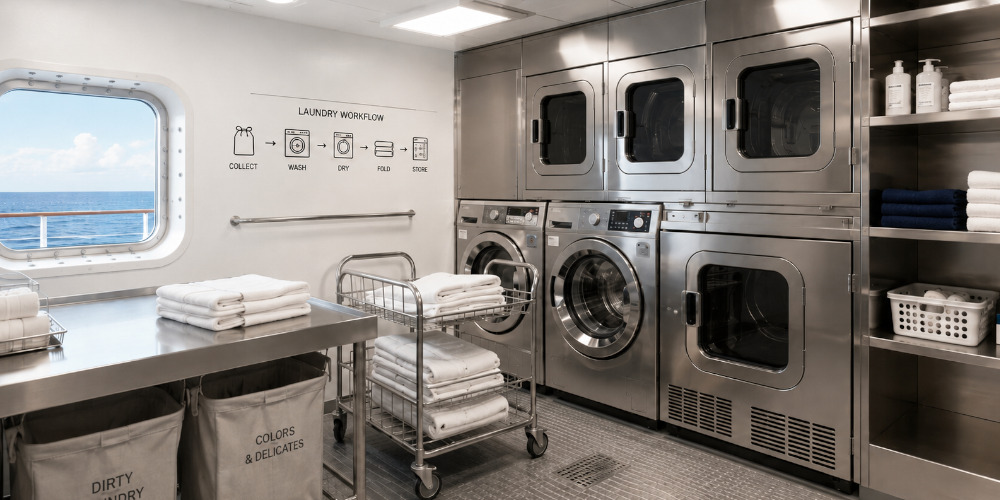
The guide to efficient equipment for ship laundries recommends the "linear workflow" principle in space planning: the entry of dirty textiles, washing, drying, ironing, and the exit of clean products should follow a sequence where paths never cross.
Critical Criteria for Equipment Selection
Marine-grade laundry equipment must possess distinct features compared to domestic or standard industrial machines:
-
Vibration and Balance: Washers must be equipped with specialized shock absorber systems to operate stably even while the ship is in motion.
-
Corrosion Resistance: To combat the corrosive effects of sea air, all outer casings and drum parts should be manufactured from high-quality stainless steel.
-
Resource Efficiency: To protect limited resources on board, machines with "Eco" modes that ensure low water and electricity consumption are preferred.
The Importance of Stainless Steel Furniture: Durability and Hygiene
The laundry environment involves high humidity and chemical vapors. Therefore, workbenches, trolleys, and shelving must be selected from laundry stainless steel furnitures:
-
AISI 316L Quality: Provides the highest resistance against chemical detergents and salt water.
-
Mobility: Stainless steel trolleys with reinforced casters allow heavy textile loads to be moved easily through narrow corridors.
-
Ergonomics: Stainless steel sorting and folding tables should be designed at heights and widths that increase the operational efficiency of the staff.
The Path to Operational Excellence
Laundry systems on yachts and ships are not merely logistical hubs; they are cornerstones of crew satisfaction and guest comfort. Selecting the right equipment and ensuring a compliant installation reduces maintenance costs in the long run while increasing operational reliability. In the ships of the future, laundries integrated with water recovery systems and digital tracking interfaces will become the standard.