A superyacht galley is a much more challenging work environment than industrial kitchens on land. Chefs must produce flawless dishes in a limited space, on a moving floor, and under intense pressure. Therefore, design in yacht kitchens must focus on functionality and safety before aesthetics. An ergonomic layout reduces staff fatigue, prevents accident risks, and increases service speed. UNOKS transforms narrow spaces into high-performance production centers with its maritime experience.
The "Work Triangle" and Maritime Adaptation
The golden rule of kitchen design, the "Work Triangle" (Storage, Preparation, Cooking), applies more strictly on yachts. The chef must move between these three points with minimum steps.
U and L Type Layouts
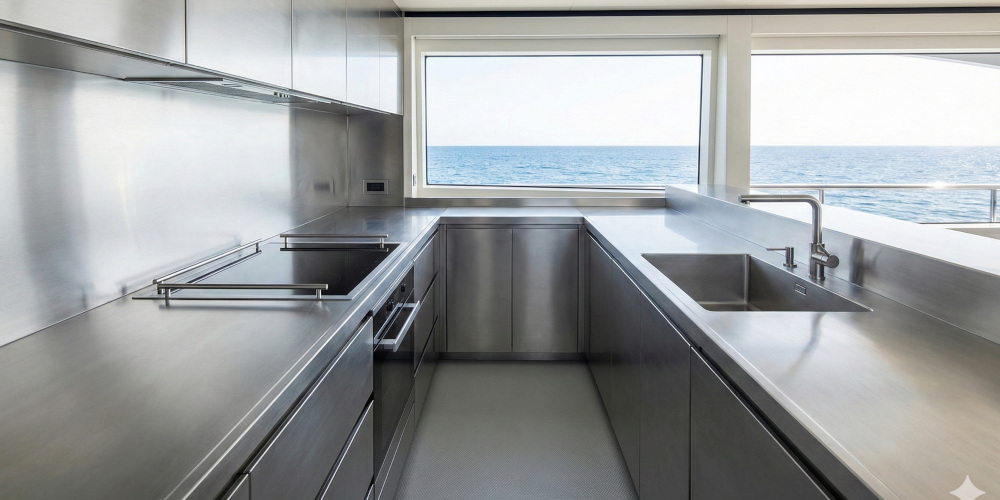
U-type layouts are generally the most efficient plans on yachts. This design allows the chef to reach all stations with just a turning motion while standing in the center. It also offers a narrow corridor where the chef can hold on and maintain balance in rough weather. L-type galleys are preferred in wider spaces where multiple staff members work.
Management of Traffic Flow
The paths of service staff (stewardesses) and the galley team must not intersect. The return point for dirty dishes and the exit point for clean plates (pass area) must be physically separated. This separation prevents cross-contamination risks and prevents chaos during service.
Safety Measures for Moving Floors
The main factor distinguishing a yacht galley from a home kitchen is the constantly moving floor. Ergonomics starts with ensuring safety in this environment.
Rails
Fiddle rails must be present on counter and stove edges. These metal barriers prevent pots and preparation bowls from sliding and falling in rough seas. In UNOKS designs, these rails are produced modularly to be removable or adjustable during cleaning.
Positive Lock Systems
Cabinet doors and drawers must not open spontaneously when the boat tilts. Magnetic catches are insufficient in sea conditions. "Push-to-open" or mechanical latch (push-lock) systems are mandatory. Drawers containing heavy pots can injure staff during sudden openings. Therefore, soft-close rail systems with brakes must be used.
Storage and Space Management
Every cubic centimeter is valuable on yachts. There is no luxury of leaving dead space.
Vertical Storage: Floor-to-ceiling cabinets must be used. Frequently used items go at eye level, while rarely used ones go on top shelves.
GN Pan System: Fridges and drawers must comply with international Gastronorm (GN) standards. This way, a prepared product can enter the oven or cold storage without changing its container.
Corner Solutions: Corner cabinets are usually blind spots. Rotating shelf mechanisms (Lazy Susan) or pull-out units include these areas in active storage.
Table 1: Comparison of Standard Land Kitchen vs. Ergonomic Yacht Galley
|
Feature |
Standard Land Kitchen |
Ergonomic Yacht Galley |
|
Counter Edge |
Flat finish |
Raised edge (Marine Edge) - Prevents liquid spills |
|
Stove Type |
Gas or Electric |
Induction (Emits less heat, easy to clean) |
|
Floor |
Ceramic/Tile |
Non-slip Epoxy or Special Rubber |
|
Equipment Fixing |
Free standing |
Bolted to Floor/Wall (Flanged feet) |
|
Ventilation |
Standard extraction |
High capacity, variable speed, and fire suppression system |
Material Selection and Hygiene
The marine environment accelerates corrosion. Kitchen furniture and devices must be manufactured from 304 or superior 316 grade stainless steel. Wood or laminate surfaces can absorb moisture, turn into bacteria nests, and rot over time.
Stainless steel is the most hygienic material with its non-porous structure. Countertop joints must be welded and sanded. Rounded internal corners (radius) should be preferred instead of sharp corners. This detail prevents dirt accumulation and makes cleaning easier.
Air Conditioning and Lighting
Ovens and dishwashers working in a small space heat the environment rapidly. Insufficient ventilation reduces the chef's performance. The hood system must be powerful enough to evacuate excessive heat alongside odors.
Shadow formation must be prevented in lighting design. LED spots clearly illuminating the countertop surface must be used. Daylight (4000K-5000K) showing the true color of food should be preferred instead of yellow light.
An ergonomic yacht galley is the guarantee of delicious meals and a happy crew. Correct project planning eliminates obstacles limiting the chef's abilities. UNOKS combines industrial kitchen experience with maritime rules to create spaces offering 5-star service even on waves.