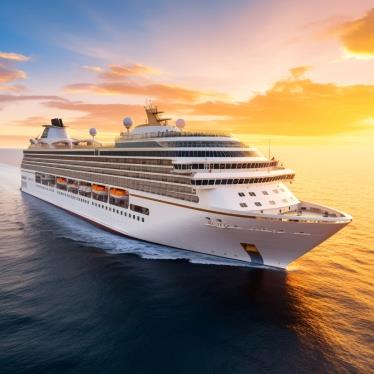
Managing organic refuse on a cruise ship is a complex logistical challenge that directly intersects with maritime law, environmental stewardship, and public health. With thousands of passengers and crew generating metric tons of food scraps daily, a vessel's marine waste management system must be both high-capacity and technologically advanced. Unlike land-based systems, shipboard waste processing must occur within the strict parameters of MARPOL Annex V regulations while maintaining a sterile environment in the galley. Efficient food waste management is not merely about disposal; it is about creating a seamless, hygienic workflow that reduces the volume of refuse and eliminates the biological risks associated with organic decomposition in a confined maritime setting.
The Role of the Marine Food Waste Disposer
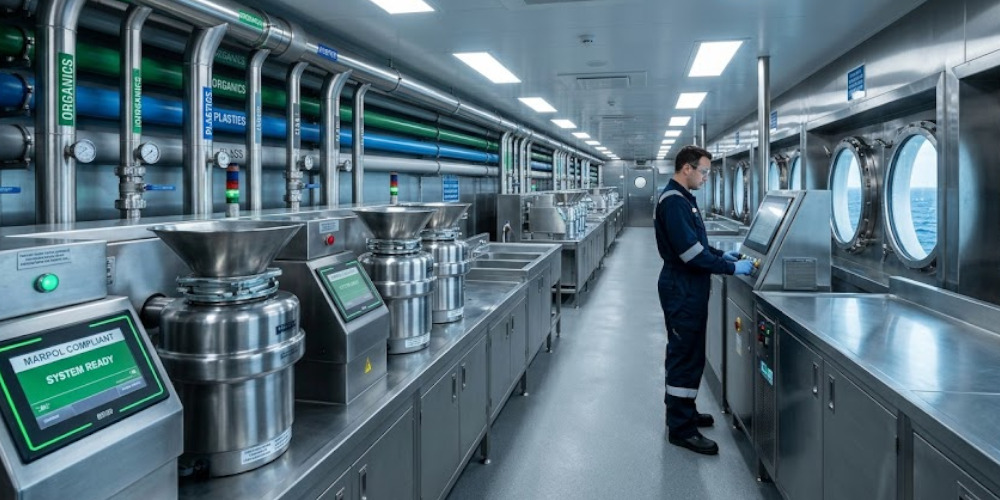
The primary line of defense in managing organic output is the industrial-grade marine food waste disposer. These high-torque machines are engineered to grind diverse food waste—including bones and fibrous husks—into a fine slurry.
Technically, these units operate by utilizing heavy-duty centrifugal force and precision-machined grinding elements to reduce solids to particles smaller than 25mm. This process is critical for two reasons:
-
Discharge Compliance: MARPOL regulations permit the discharge of food waste into the sea only if it has been comminuted and can pass through a screen with openings no greater than 25mm.
-
Volume Reduction: For vessels storing waste for port disposal, maceration significantly increases storage density, allowing the ship to maintain autonomy for longer periods without the need for offloading.
Maintaining Galley Hygiene and Preventing Contamination
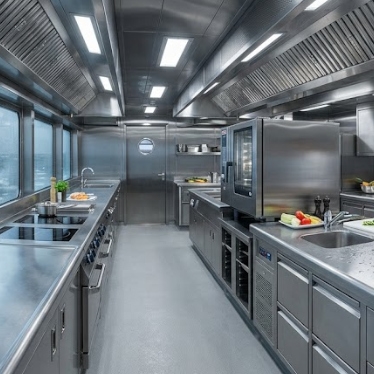
In a high-intensity cruise ship galley, the accumulation of food waste is a primary vector for bacterial growth and pest infestation. Operational efficiency depends on a "point-of-origin" disposal strategy. Integrating disposers directly into the preparation and pot-washing stations allows the culinary team to eliminate waste instantly, preventing the buildup of organic matter on work surfaces.
From a hygiene perspective, modern disposal systems are designed with stainless steel housings (AISI 316L) and easy-clean geometries to prevent "biofilm" accumulation. Effective waste management also includes odor control; by processing food waste into a liquid slurry that can be held in sealed tanks or discharged, the galley remains free of the pungent gases produced by decaying solids, thereby protecting the air quality for both the crew and the guests in adjacent dining areas.
MARPOL Annex V and Environmental Compliance
The legal framework for cruise ship food waste management is governed by MARPOL Annex V. This international treaty strictly prohibits the discharge of all plastics and limits the disposal of food waste based on the vessel's distance from the nearest land and whether it is operating within "Special Areas" (such as the Baltic or Mediterranean Seas).
-
Outside Special Areas: Comminuted food waste can be discharged at a distance of more than 3 nautical miles from land.
-
Inside Special Areas: Discharge is generally only permitted beyond 12 nautical miles.
-
Operational Recording: Every discharge or incineration event must be meticulously logged in the Garbage Record Book.
Failure to comply with these standards can result in massive fines and damage to a cruise line’s reputation. Therefore, the reliability of the onboard processing hardware is paramount to ensuring the vessel remains "in class" and legally compliant.
Integrated Waste Systems for Sustainable Cruising
Modern cruise ships are increasingly moving toward "Zero Waste to Landfill" targets. This involves a multi-stage approach where food waste is not just macerated but often dehydrated or processed via anaerobic digestion to further reduce its mass.
Integrated systems connect food waste disposers to a centralized vacuum transport network, moving the slurry to technical spaces below deck. This removes the need for crew members to manually transport heavy bins through the galley, reducing the risk of workplace injuries and cross-contamination. By optimizing this logistical chain, cruise operators can lower their operational expenditures (OPEX) while significantly enhancing the sustainability of their maritime operations.