There is a point in time that most sailors will tell you they've been through. They're cruising across the open ocean, the engine is barely humming, and everything seems to be calm... until someone grimaces, or becomes dizzy, or burns their shoulder because they "just forgot sunscreen for five minutes." That's usually when they remember the sea is both stunning and rather unpredictable.
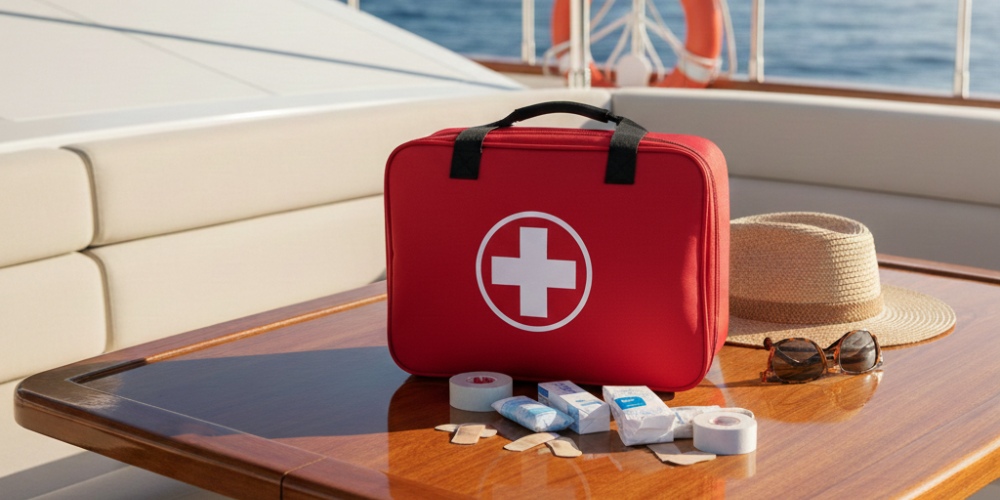
A yacht is not a floating emergency room and it will never act like it is either. However, a yacht cannot rely on land-based assistance in the same way it does while docked. Therefore, creating a complete first aid kit is a sort of ritual for those who enjoy being near the water - a balance between being practical and old school self-sufficiency.
You may wonder why sailors place such a large emphasis on preparation. It is because problems can escalate rapidly when the closest medical center is hours away. For example, a mosquito bite can become swollen, a gastrointestinal issue can occur at the worst time, or a cut can become contaminated quicker than you can imagine. To be honest, even the most experienced captains can occasionally forget an item that turns out to be extremely important.
Let's break this whole "yacht first aid kit" concept down piece by piece. Some of these items are obvious, some are... somewhat easily overlooked, but together they create the kit that quietly saves the day more often than sailors will admit.
Why Minor Medical Emergencies At Sea Are More Serious Than Most People Think
Yachting appears glamorous at times and at others it certainly is. The sea, however, has a distinct personality, especially during the warmer months. Mosquitoes are relentless in coastal regions, sun exposure is far worse than you'd think even when you have a cloudy sky overhead, and motion sickness is completely unaware of how many years of sailing experience you have.
Most minor medical emergencies fall into the following four categories:
- Stings and bites that initially appear harmless but could potentially lead to swelling or allergic reactions.
- Joint and muscle pain resulting from unexpected movements or poor footing on the deck.
- Unexpected stomach issues that come seemingly from out of nowhere - sometimes due to food, sometimes due to motion, and other times due to unknown causes.
- Small injuries, such as cuts, bruises, or burns.
The difficult aspect of each category is the combination of movement, saltwater, and the fact that medical assistance is likely several hours away. A minor cut that you would typically brush off at home requires significantly more attention on a yacht. Saltwater does not sterilize wounds - another common myth among sailors.
Back to sailors... they understand that having both the correct materials and basic knowledge will assist greatly with any problem that arises.
What Should Be Included In Your Yacht First Aid Kit & Why?
An ideal kit isn't simply a jumbled box of pills. Instead, it is a carefully selected group of tools designed to address predictable problems. Below, everything is categorized by the specific types of issues sailors commonly encounter, along with brief explanations that are obvious until you are in the middle of the ocean trying to remember "I should have brought that."
For Motion Sickness
Motion sickness is a sailor's nemesis, and the timing is particularly bad. Even seasoned sailors are often caught off guard.
- Nausea and motion sickness medication (tablets, pills, and suppositories).
- As previously mentioned, suppositories are essential when the individual is unable to keep oral medication down.
- Remind the ill individual to stare at the horizon.
- Instruct the individual NOT to lean over the side while feeling dizzy.
Guidelines for long-distance sailing suggest approximately one-third of all passengers will experience some type of motion sickness in choppy waters - plus or minus a few percent. This is fairly astounding considering how common motion sickness is.
For Pain and Fever
Pain management is essentially your "comfort insurance" on a yacht.
- General-purpose pain relievers for mild to moderate pain.
- Fever reducers.
- Muscle relaxant creams or tablets.
- Epinephrine sublingually for heart-related emergencies or severe allergic reactions.
- Pain relieving suppositories (once again, great for individuals experiencing nausea).
You don't need an entire pharmacy here, but the basics are incredibly more valuable than most people realize.
For Burns and Sun Exposure
Sun is deceiving at sea. Even when it is cooler, reflected sunlight from the water increases the amount of UV radiation you receive.
- High SPF sunscreen that is actually used, not just stored.
- Burn gels to cool and relieve the skin.
- Sterile dressing for minor burns.
- It is worth noting that new sailors frequently underestimate how quickly a burn can become infected, therefore ensuring the burn is covered appropriately is not optional.
A somewhat awkward tip that many skippers claim works is to apply sunscreen prior to starting the engine. It sounds ridiculous, but it is effective.
For Allergic Reactions
Allergies are unpredictable, and the timing at sea is critical.
- Antihistamines (in tablet or gel form) to alleviate allergic symptoms.
- Corticosteroids (in cream or tablet form) to reduce inflammation.
- EpiPen for life-threatening allergic reactions.
- Review the EpiPen instructions prior to needing to use it - do not attempt to figure out how to use it in a state of panic.
Many sailors attach a boldly printed label to the EpiPen case indicating "USE ONLY IF YOU ARE HAVING TROUBLE BREATHING." While it is not pretty, clarity is paramount during chaotic situations.
For Gastrointestinal and Digestive Issues
Movement of a yacht can exacerbate even minimal gastrointestinal discomfort.
- Medications for gas, indigestion, diarrhea, constipation.
- Recommend hydration and high-fiber diets to minimize the risk of constipation.
- Include oral rehydration salts in the kit - they take up very little space and will prove beneficial more than you can imagine.
In many cases, the easiest treatments will be the ones that save the majority of the remainder of the voyage.
For Cuts, Bruises, and Other Types of Deck Injuries
Saltwater stings on open wounds but it also increases the likelihood of infection.
- Sterile solution or sterile saline for flushing wounds.
- Gauze pads, bandages, and elastic wraps of varying sizes.
- Adhesive strips and Steri-Strips.
- Scissors, sterile gloves, and tweezers.
- Lightweight neck bracing.
- Digital blood pressure cuff.
When dealing with minor cuts: Clean, Dry, Bandage.
When dealing with larger cuts: Close using Steri-Strips and seek medical assistance immediately after.
It is somewhat inaccurate but one true observation: people always cut themselves on the same three objects - knives, fishing gear, and sharp edges nobody ever fixes.
The Golden Rules All Prepared Sailors Live By
While none of these rules are particularly complex, they are consistently repeated for a reason.
- Store your personal prescription medications in a designated, clearly labeled bag.
- Ask your guests to bring their prescribed medications. Not "perhaps," but definitely.
- Maintain a list of nearby medical facilities' phone numbers.
- Clearly mark and label everything.
- Insert a small, waterproof first aid manual within the kit.
First aid kits are useless if the individuals aboard the vessel have no idea what they are looking at.
Why Preparation Saves Lives At Sea
Preparing at sea is not dramatic. It is quiet, peaceful, almost uneventful. Yet, in that tranquility, lies its value. When the closest hospital is hours away, preparation is your safety net. Honestly, once sailors prepare a first aid kit, they rarely revert back to the minimalist method of preparation.
Having a well-prepared first aid kit provides smoother sailing, less panic, and a greater sense of control, even when the weather and waves decide to be unruly.
Therefore, the next time you board your yacht and you begin to feel the wind whispering at you, a long day ahead, glance at that kit again. Is it stocked with the essentials? It is a relatively simple habit, yet it may one day make all the difference.
FAQ
Will a standard household first aid kit suffice for a yacht?
No, it won't. Conditions at sea, combined with distance from medical assistance and constant movement require additional items, primarily for motion sickness, burns, cuts, and allergic reactions.
How often should I review the kit?
Every 2-3 voyages. Prescription medications expire quietly, and dressings absorb moisture at a faster rate than you would anticipate on a boat.
Must I undergo formal first aid training to utilize the kit?
Formal training can be beneficial, but even the most basic actions, such as cleaning a wound or administering antihistamines, can be life-saving when done promptly.
Should the kit be waterproof?
Yes, absolutely. Although "protected" storage spaces tend to develop humidity while afloat, water-resistant bags or cases are necessary.
Where should I store the kit?
Somewhere visible, accessible, and not hidden beneath layers of equipment. Seconds count in emergencies.