On a cruise ship or a large offshore vessel, the laundry department is a high-pressure hub that never truly stops. With thousands of linens, towels, and uniforms requiring a 24-hour turnaround, efficiency is not just a goal—it is a requirement for survival. Improving this efficiency while reducing costly downtime requires a three-pronged approach: intelligent space planning for marine laundries, the selection of rugged marine laundry equipment, and the integration of specialized laundry stainless steel furnitures. When a single component fails in the middle of the ocean, the ripple effect on guest satisfaction and crew logistics can be monumental.
Strategic Space Planning: The Workflow of Cleanliness
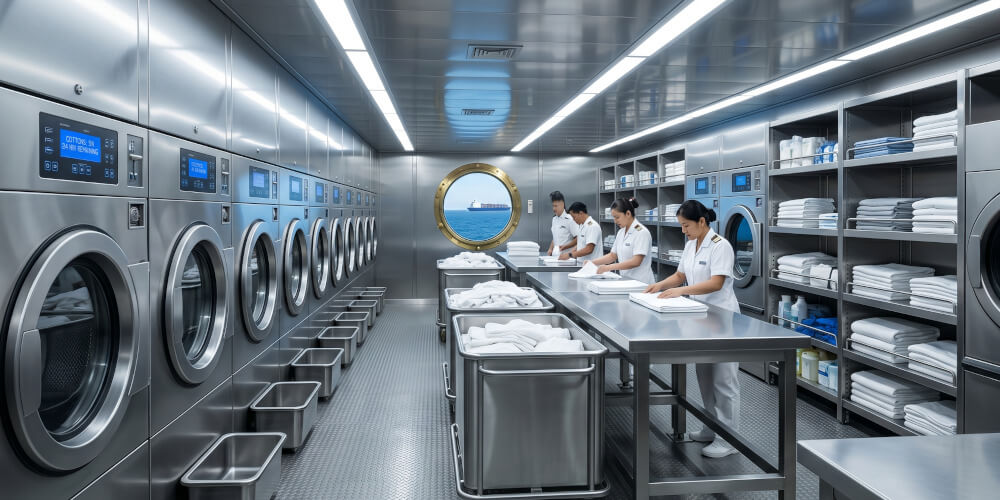
Efficiency begins with the floor plan. In the confined spaces of a ship, every centimeter must serve the "linear flow" of textiles. A well-designed laundry prevents the most common bottleneck: cross-contamination and backtracking.
-
The "Dirty-to-Clean" Path: The layout must ensure that soiled linens enter at one end and emerge pressed and folded at the other without ever crossing paths. This flow minimizes movement time and ensures strict hygiene standards.
-
Ergonomic Integration: Space planning isn't just about where the machines go; it's about how the crew interacts with the workspace. Specialized furniture must be positioned to support the natural reach and movement of the staff, reducing physical fatigue during long shifts.
-
Vertical Optimization: Utilizing high-capacity wall-mounted shelving and stackable units maximizes square footage, allowing for more processing power in smaller footprints.
The Role of Specialized Stainless Steel Furniture
While machines do the heavy lifting, the furniture provides the infrastructure for efficiency. Standard furniture will quickly fail in the humid, chemical-heavy environment of a maritime laundry.
-
Corrosion Resistance: Exposure to high humidity and aggressive industrial detergents requires AISI 316L stainless steel. This material ensures that sorting tables and trolleys remain rust-free, preventing permanent stains on expensive guest linens.
-
Customized Utility: From mobile laundry trolleys with reinforced casters to heavy-duty sorting tables with raised edges, specialized laundry stainless steel furniture is designed to keep textiles off the deck and organized throughout the washing cycle.
-
Hygiene and Maintenance: Non-porous surfaces are essential for preventing the buildup of mold and bacteria. Stainless steel furniture is easy to sanitize, ensuring the "clean" side of the operation stays truly sterile.
Selecting High-Performance Marine Grade Equipment
Marine laundry systems must be engineered to handle the unique physical stresses of a moving vessel.
-
Vibration Dampening: Shipboard equipment must feature reinforced frames. Because machines are often bolted directly to the steel deck, internal dampening is critical to prevent vibrations from echoing through the hull.
-
Compact Power: Marine-spec washers often feature tilted drums for easier unloading in rolling seas and dimensions that fit through standard ship bulkheads without requiring structural modifications.
Reducing Downtime Through Preventative Engineering
Downtime at sea is significantly more expensive than on land. Reducing it is a matter of "engineering for access."
-
Maintenance-Friendly Design: Choose equipment where critical components are accessible from the front or side panels. This allows the onboard engineering team to perform repairs without dismantling the entire laundry line.
-
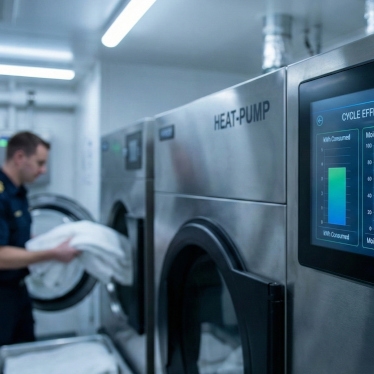
Digital Diagnostics: Modern systems include smart controllers that track cycle counts and alert the crew to early signs of wear before a machine breaks down.
-
Redundancy Planning: Utilizing multiple mid-sized units instead of one massive machine ensures that if one unit requires maintenance, the others can continue to operate, keeping the laundry flow at 75-80% capacity.
The ROI of an Efficient Laundry
An optimized marine laundry system is an invisible engine of guest satisfaction. By prioritizing high-grade 316L materials, implementing a logical "dirty-to-clean" workflow, and selecting equipment and furniture designed for the rigors of the sea, operators can significantly lower their OPEX. Reducing downtime isn't just about fixing machines—it's about building a resilient system that supports the vessel's 5-star standards every single day.