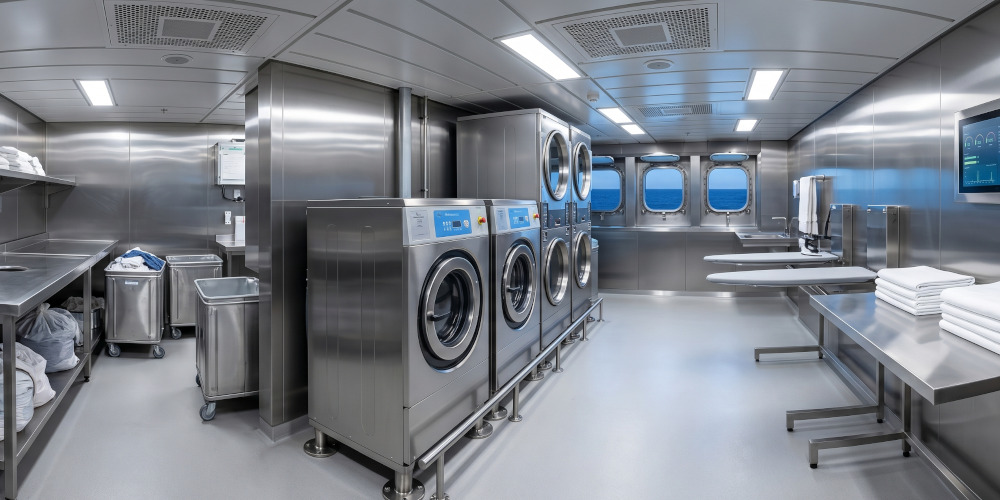
On a maritime vessel, space is the most expensive commodity. Designing a laundry room within the tight, vibrating confines of a hull requires more than just cramming machines into a corner; it requires a deep understanding of logistical flow, moisture control, and structural integrity. Effective marine laundry space planning transforms a chaotic, humid basement into a high-performance industrial hub. Whether you are outfitting a bulk carrier with a small crew or a superyacht with high-turnover linens, the goal remains the same: minimizing physical steps while maximizing throughput. An inefficient layout doesn't just waste time—it increases operational costs and jeopardizes the hygiene standards necessary for long-term deployments.
The Linear Workflow: From Dirty to Clean
The golden rule of any industrial laundry, especially at sea, is the "Linear Flow" principle. To prevent cross-contamination and logistical bottlenecks, the layout must follow a strict one-way path: Sorting → Washing → Drying → Folding/Ironing → Storage.
-
Zoning: Physical separation between the "soiled" entry point and the "clean" exit point is mandatory. In tight spaces, this can be achieved through height-adjustable laundry stainless steel furniture like sorting tables and shelving units that utilize vertical space.
-
Vibration and Structural Loads: Large washer-extractors generate immense G-forces. Space planning must account for reinforced plinths and positioning machines over structural frames to minimize harmonic vibration throughout the vessel.
-
Workflow Integration: By positioning high-capacity marine laundry equipment in a sequence that mimics the chemical and mechanical process, you reduce the manual transport of heavy, wet linens—a major cause of workplace fatigue and injury.
Strategic Equipment Positioning for Maintenance
A common mistake in ship laundry layout is neglecting "maintenance envelopes." Every piece of equipment requires clear access for filter cleaning, belt checks, and electrical servicing.
|
Feature |
Space-Saving Strategy |
Benefit |
|
Washer-Extractors |
Side-by-side with 20cm service gap |
Easier access to plumbing/drains |
|
Drying Tumblers |
Stacked configurations (if height permits) |
Halves the footprint requirement |
|
Ironing/Folding |
Wall-mounted or foldable stainless tables |
Clears floor space when not in use |
|
Chemical Dosing |
Centralized wall-mounted racks |
Prevents floor-level chemical spills |
Beyond physical placement, modern systems now utilize marine laundry monitoring technologies and digital tracking. Integrating these digital hubs into the space plan—typically at eye-level near the exit—allows operators to track machine status and cycle efficiency in real-time without obstructing the physical path of the crew.
Managing the Internal Environment: Heat and Moisture
An efficient laundry system is only as good as its climate control. Compact marine laundries can quickly become "saunas" if ventilation is poorly planned.
-
Exhaust Ducting: Dryer exhaust must be as short and straight as possible to maintain efficiency.
-
Moisture Extraction: High-G washer-extractors are critical; the more water removed mechanically, the less heat and moisture are released into the room by the dryers.
-
Thermal Efficiency: As detailed in our energy consumption analysis of marine laundry equipment, using heat-pump dryers or heat recovery systems can significantly lower the ambient temperature in the room, making the space safer and more comfortable for the crew.
The Synergy of Furniture and Machinery
Ultimately, a successful marine laundry setup is a synergy between durable machinery and the ergonomic furniture that supports it. By using AISI 316L stainless steel for all folding tables and trolleys, you ensure a rust-free environment that can withstand the high humidity and heavy loads of maritime service. When every square centimeter is calculated to support a logical, linear path, the laundry operation becomes a seamless part of the ship's daily rhythm rather than a logistical bottleneck.