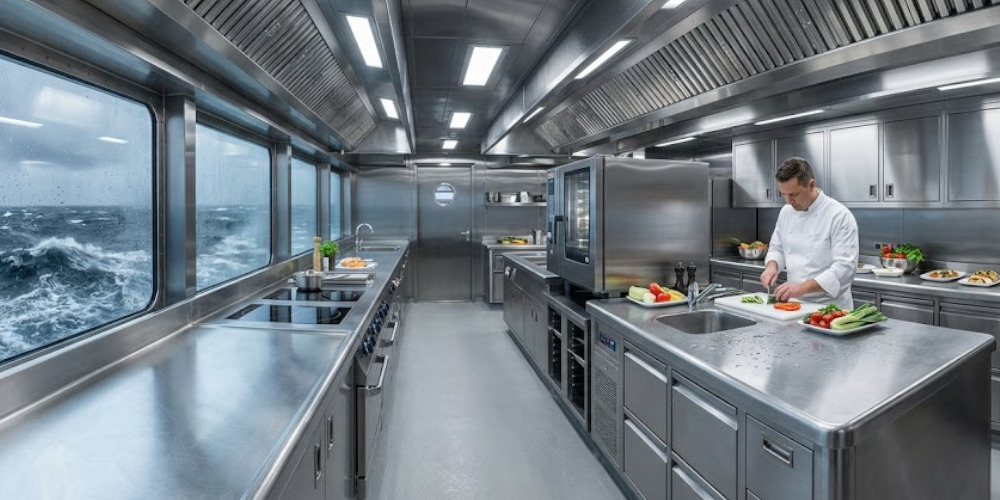
In the high-stakes environment of maritime catering, the selection of fabrication materials is a critical engineering decision that directly impacts a vessel's operational lifespan, safety rating, and maintenance overhead. Professional marine galley design relies almost exclusively on high-grade stainless steel—specifically AISI 316L—to withstand the relentless assault of saline air, high humidity, and mechanical stress. Unlike land-based commercial kitchens, a shipboard galley must function as an autonomous, sterile, and fire-secure hub for weeks at a time. Stainless steel is not merely an aesthetic preference; it is a structural necessity that ensures the galley remains a compliant and high-performing asset throughout the ship's lifecycle.
Unrivaled Corrosion Resistance in Saline Environments
The primary threat to any maritime infrastructure is chloride-induced corrosion. Standard metals and lower-grade alloys oxidize rapidly when exposed to the salt-laden atmosphere of the open sea. Professional galley stainless steel furniture is engineered to counteract this through the use of molybdenum-enriched alloys.
-
Pitting Resistance: The addition of molybdenum in 316L stainless steel provides superior resistance to pitting and crevice corrosion compared to the 304 grade used on land.
-
Structural Longevity: By resisting the deep-seated decay caused by saltwater, stainless steel furniture maintains its load-bearing capacity and aesthetic finish for decades.
-
Integrated Solutions: This same level of metallurgical protection is required across all technical spaces, which is why laundry stainless steel furniture also utilizes these marine-grade specifications to handle the humid, chemical-heavy environment of a ship's laundry room.
Absolute Hygiene and USPHS Compliance
Food safety at sea is governed by rigorous international standards, including the USPHS (United States Public Health Service) guidelines. Stainless steel is the only material that offers a completely non-porous surface, which is essential for maintaining shipboard food preparation hygiene and safety standards.
Because the surface has no microscopic pores or cracks, bacteria, viruses, and mold have no place to colonize. This makes the sanitization process both faster and more effective. In fact, the hygiene requirements in a professional marine galley are so high that they often mirror those found in clinical environments, utilizing the same technical principles as stainless steel equipment for medical products to ensure zero cross-contamination.
Fire Safety and Mechanical Durability
A fire in a ship's galley is one of the most dangerous scenarios a crew can face. Stainless steel provides a critical layer of passive fire protection:
-
Non-Combustibility: Stainless steel does not ignite or contribute to the spread of flames.
-
Thermal Integrity: It retains high structural strength even at elevated temperatures, preventing the collapse of heavy cooking equipment during a thermal event.
-
Impact Resistance: In heavy seas, the galley is subject to intense vibration and impact. Stainless steel’s high ductility allows it to absorb energy without cracking, ensuring that latches, hinges, and supports remain functional.
Table 1: Material Performance Comparison for Marine Use
|
Feature |
Marine Grade Stainless (316L) |
Standard Aluminum |
Coated Carbon Steel |
|
Saltwater Resistance |
Excellent |
Moderate (Pits easily) |
Poor (Rusts if chipped) |
|
Hygiene (Non-porous) |
Best |
Good |
Poor (Coating degrades) |
|
Fire Safety |
Highest |
Low Melting Point |
High |
|
Maintenance Need |
Very Low |
High |
Very High |
|
Lifespan |
25+ Years |
5–10 Years |
3–7 Years |
Economic Sustainability and Maintenance
While the initial capital expenditure (CAPEX) for marine-grade stainless steel may be higher than alternative materials, the total cost of ownership is significantly lower. The "stain-less" nature of the alloy means that maintenance routines are simplified, requiring only fresh water and mild detergents. There is no need for toxic anti-corrosion coatings or frequent repainting, which reduces long-term operational expenditures (OPEX) and ensures the vessel stays in service without the need for costly galley refurbishments during dry-dock periods.
Mastering the use of stainless steel in galley design transforms the kitchen into a resilient, autonomous, and sterile environment that can withstand the most punishing conditions on Earth.