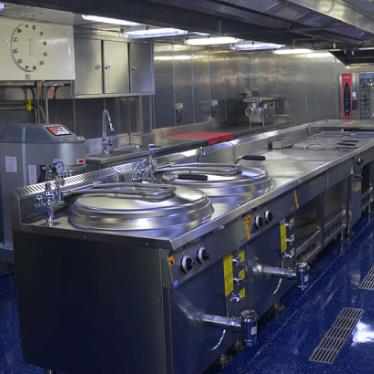
The strategic execution of marine cold storage planning is the linchpin of operational continuity and food safety on any maritime vessel. Whether outfitting a commercial freighter for a 40-day oceanic crossing or designing a luxury superyacht for extended cruising, the ability to safely preserve perishable provisions defines the vessel's autonomy. Unlike shore-based facilities, shipboard refrigeration systems must operate flawlessly in environments characterized by constant pitch and roll, extreme ambient temperatures, and highly corrosive salt-laden air. Food safety is not merely a compliance metric; it is a critical survival factor at sea. An undersized or inefficient cold storage system can lead to rapid food spoilage, severe health crises, and the premature termination of a voyage. Consequently, modern ship kitchen cold storage requires a highly engineered approach that balances thermodynamic efficiency with severe spatial constraints.
Capacity Calculation and Energy Consumption
Determining the precise capacity for marine refrigeration requires complex logistical calculations based on the maximum number of souls on board (crew and guests), the planned duration of the longest voyage without resupply, and the specific dietary profiles required. Engineers must calculate the thermal load required to bring ambient-temperature provisions down to safe storage levels while factoring in the high ambient heat generated by the galley equipment itself.
Energy consumption is a paramount concern. Refrigeration systems run 24/7, placing a continuous baseline load on the ship’s electrical generators. To mitigate this, marine cold storage utilizes high-density, CFC-free polyurethane foam insulation (often 80mm to 100mm thick) to prevent thermal bridging. Furthermore, the integration of dual, variable-speed compressors and marine-grade condensers ensures that the system only draws maximum power during peak loads or pull-down phases, operating at a highly efficient idle state during standard maintenance periods.
Cold Rooms vs. Modular Cabinet Systems
A fundamental engineering decision in galley design is choosing between built-in walk-in cold rooms and modular cabinet systems. Walk-in cold rooms offer massive volume consolidation and are the standard for large commercial vessels and cruise ships. They allow for bulk pallet storage and utilize remote compressor racks located in the engine room to remove noise and heat from the galley. However, they require a significant permanent footprint and complex structural integration into the hull.
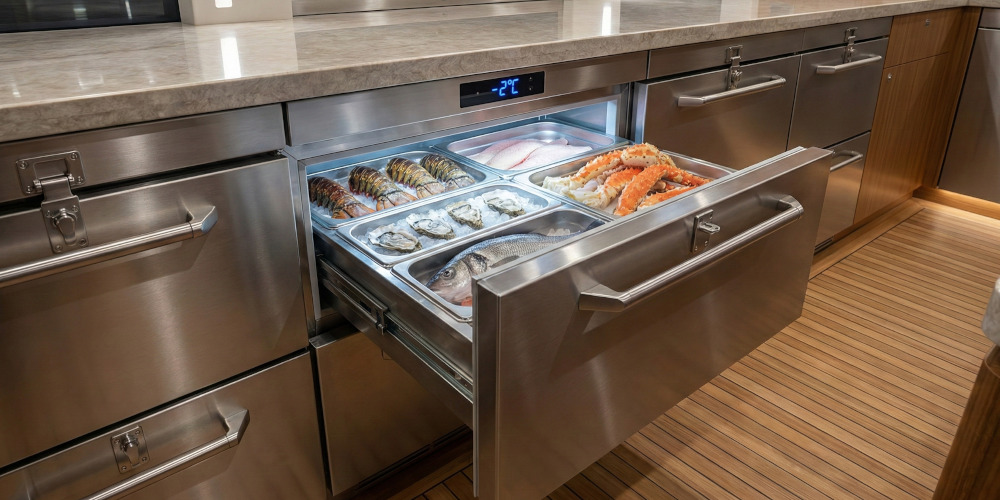
Conversely, modular cabinet systems are the preferred solution for yacht galley refrigeration and vessels with highly restricted spaces. Integrating advanced, heavy-duty marine refrigerators allows for decentralized storage. Undercounter drawer fridges and upright modular cabinets offer unparalleled flexibility, enabling chefs to position specific ingredients directly at their prep stations (e.g., a fish drawer directly under the seafood prep counter). Modular systems also offer superior redundancy; if one cabinet fails, the others continue to operate, whereas a complete failure of a centralized cold room can jeopardize the entire ship's food supply.
Layout Strategy and Food Safety Compliance
The physical layout of the cold storage infrastructure must strictly adhere to Hazard Analysis Critical Control Point (HACCP) principles to prevent cross-contamination. Raw proteins, dairy, and fresh produce must be physically isolated, demanding either partitioned cold rooms or dedicated modular cabinets operating at different temperature set-points. Ship kitchen cold storage must feature positive-locking latches to ensure doors remain hermetically sealed during heavy seas, preventing temperature fluctuations and physical spills.
Additionally, continuous digital temperature monitoring is mandatory. Modern marine cold storage systems are integrated into the vessel’s central alarm network, instantly alerting the bridge or the chief engineer if a compartment deviates from its programmed safety threshold.
Ultimately, flawless marine cold storage planning transforms the galley from a vulnerable logistical bottleneck into a highly resilient, autonomous food preparation hub. By carefully balancing total capacity needs with energy-efficient hardware and intelligent spatial design, marine engineers ensure the health, morale, and operational continuity of the entire vessel, regardless of the voyage's duration.