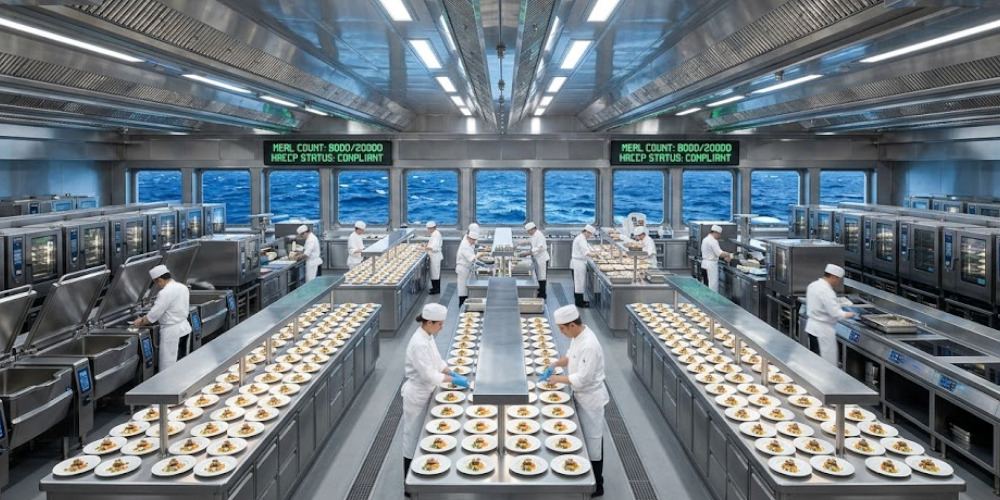
Designing a galley for a modern cruise ship is an exercise in industrial-scale logistics, precision engineering, and uncompromising hygiene. Unlike a standard merchant vessel or a private yacht, a cruise ship functions as a floating city, often requiring the preparation of tens of thousands of meals daily across multiple specialty outlets and centralized dining rooms. The complexity of these operations demands a specialized approach to vessel types, where the galley architecture must support 24/7 high-throughput service without a single point of failure. Success in cruise ship galley planning is measured by the seamless integration of heavy-duty hardware, intelligent workflow mapping (HACCP), and the ability to maintain absolute food safety under intense operational pressure.
High-Throughput Marine Equipment Selection
The backbone of a cruise ship’s culinary operation is the selection of professional marine galley equipment designed for continuous duty. In high-capacity environments, equipment is categorized by its "recovery time" and "batch capacity." For instance, massive tilting bratt pans and industrial-scale combi-ovens must be able to return to cooking temperatures almost instantly after a cold load is introduced.
Every piece of equipment must be "marine-proofed," featuring flanged feet for deck bolting, storm rails for stability, and vibration-resistant electrical components. In cruise operations, modularity is vital. By using standardized equipment footprints, technical crews can perform rapid "plug-and-play" replacements during short port stays, ensuring the galley never misses a service cycle.
Logistical Workflow and Stainless Steel Infrastructure
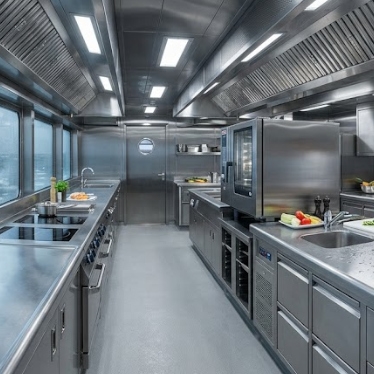
In a high-capacity galley, the physical layout is a race against the clock. The design must minimize the physical steps taken by the culinary crew while ensuring that "clean" and "dirty" flows never intersect. This structural integrity is provided by professional galley stainless steel furniture.
From heavy-duty prep tables to specialized plating stations, every surface must be fabricated from AISI 316L stainless steel to withstand the aggressive cleaning chemicals required by USPHS standards. Custom-engineered furniture with radiused (Coved) corners and seamless welds is mandatory; these design features eliminate "food traps" where bacteria could colonize, facilitating the rapid-fire sanitization protocols necessary between meal services.
Scaling Cold Storage for Thousands
Logistical autonomy on a cruise ship is dictated by its refrigeration capacity. While a yacht might focus on boutique ingredient preservation, cruise ship cold storage planning involves managing massive walk-in reefers and specialized thaws rooms.
The planning must account for:
-
Provisions Rotation: Ensuring First-In, First-Out (FIFO) access in rooms the size of small warehouses.
-
Temperature Zoning: Maintaining distinct, digitally-monitored zones for dairy, meat, seafood, and ultra-low-temp blast freezing.
-
Redundancy: Utilizing decentralized cooling circuits to ensure that a single compressor failure does not jeopardize hundreds of thousands of dollars in provisions.
Managing the Thermal Load: Ventilation Standards
High-capacity cooking generates an immense thermal load that can quickly render a galley uninhabitable and compromise the ship’s primary HVAC system. Modern cruise ship designs must strictly adhere to marine galley ventilation systems and airflow standards to ensure environmental safety.
High-velocity extraction hoods equipped with UV-C grease-destruction technology are essential. These systems not only remove heat and smoke but also chemically break down airborne grease particles, preventing the buildup of flammable residue in the ductwork—a critical fire safety concern for vessels carrying thousands of passengers. By maintaining a precise negative pressure balance, the ventilation system ensures that cooking odors remain confined to the galley, preserving the premium guest experience in the adjacent dining areas.
Conclusion: The Synergy of Engineering and Culinary Art
Ultimately, galley planning for cruise ships is about creating a resilient, industrial ecosystem. When high-capacity equipment is perfectly synchronized with a durable stainless steel infrastructure and supported by advanced ventilation and cold storage networks, the galley becomes a high-performance engine of hospitality. For operators, this translates to lower maintenance costs, absolute regulatory compliance, and the ability to deliver a consistent, five-star culinary experience regardless of the sea state or the scale of the guest list.