Marine Laundry Equipment: A Complete Buyer's Guide
Selecting the right marine laundry equipment is a critical decision that directly impacts operational costs, hygiene compliance, and crew comfort across all vessel types. Unlike land-based facilities, a ship laundry system operates within a high-stakes, resource-constrained environment where equipment downtime can compromise safety and compliance. Whether outfitting a commercial cargo ship, a naval vessel, or a luxury cruise liner, understanding the technical specifications and structural requirements of marine-grade machinery is essential for establishing an efficient utility hub.
Structural Integrity: The Requirements for Heavy Seas
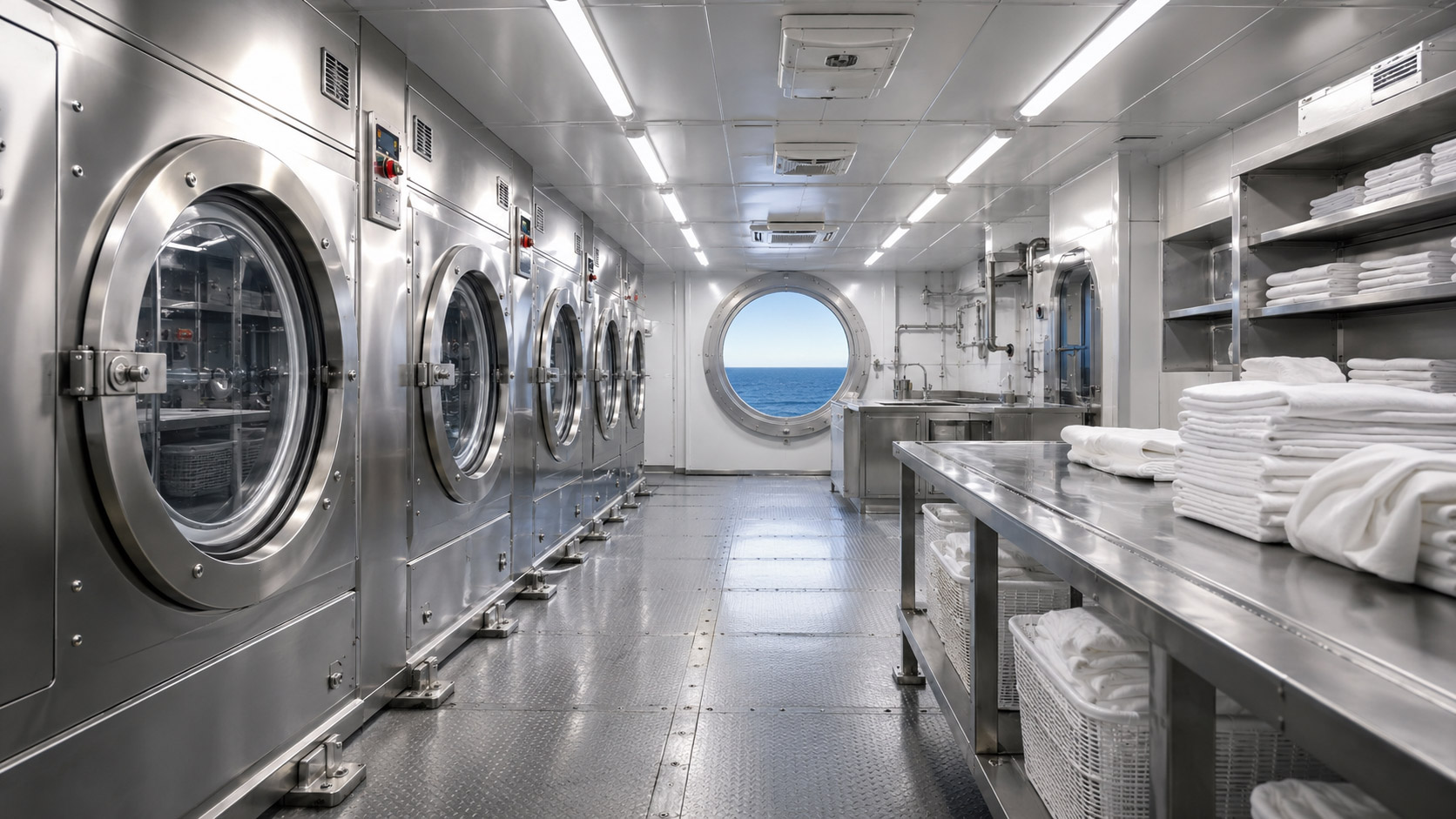
Standard industrial appliances will rapidly fail under the mechanical stresses of a moving vessel. A professional vessel laundry room requires hardware engineered from the ground up for maritime deployment.
- AISI 316L Stainless Steel Construction: Exposure to salt-laden air and aggressive laundry chemicals demands premium corrosion resistance. High-quality marine machinery utilizes 316L stainless steel for outer casings, inner drums, and critical structural frames to prevent rust and material degradation.
- Vibration Control and Heavy-Duty Shock Absorbers: Vessels experience constant rolling, pitching, and engine vibrations. Marine washing machines must feature reinforced suspension systems and heavy-duty dampeners to execute high-speed spin cycles safely without transferring structural stress to the ship's hull.
- Rigid Marine Mounts: Equipment bases must be designed for secure seafastenings—either through heavy-duty bolting or direct welding to the deck foundation—ensuring the units remain perfectly stationary during extreme sea states.
Key Components of a Ship Laundry System
Commercial Wash-Extractors
The cornerstone of any laundry room is the wash-extractor, which must balance water extraction efficiency with resource conservation.
- High G-Factor Extraction: High-speed spin cycles generate a higher G-force, mechanically extracting more water from the fabrics. By maximizing water removal during the wash phase, the subsequent thermal drying time is significantly reduced, saving massive amounts of vessel energy.
- Intelligent Dynamic Weighing: Advanced marine washers utilize internal sensors to weigh the load and automatically calculate the exact water and detergent volume required. This prevents the costly waste of fresh water during partial load cycles.
High-Efficiency Marine Dryers
Drying textiles at sea requires managing massive thermal loads and high ambient humidity.
- Heat Pump and Axial Airflow Technology: Modern marine dryers recirculate hot air through closed-loop heat pump systems rather than venting heated air directly outside. This drastically lowers energy consumption and helps maintain stable ambient temperatures within the laundry room.
- Reversing Cylinder Action: To prevent large items like bedsheets and coveralls from tangling into a ball—which creates damp centers and extends drying times—cylinders must alternate direction consistently to ensure even airflow distribution.
Vessel Laundry Room Design and Capacity Planning
An efficient ship laundry room design relies on precise capacity planning to match the vessel's specific crew complement and operational profile.
To determine the total daily capacity required, engineers utilize a standardized capacity calculation method. This calculation multiplies the total number of persons on board by the daily linen weight allocation per person, and then divides that total by the planned operational hours of the laundry room per day. This ensures that the chosen machinery can comfortably handle the workload without running constantly.
|
Vessel Type |
Operational Profile |
Key Layout Priorities |
|
Commercial Cargo & Tankers |
Small crew, highly utilitarian, long voyages. |
Maximum mechanical durability, simple automated controls, low maintenance overhead. |
|
Naval & Military Vessels |
High crew density, strict space constraints, high risk of contamination. |
Shock-tested components, strict lint containment, compact stackable washer-dryer configurations. |
|
Cruises & Superyachts |
Large passenger counts, continuous luxury standards, multi-shift operations. |
Industrial-scale multi-machine lines, dedicated barrier washers for cross-contamination control, automated ironers. |
A successful layout must always enforce a linear workflow. The movement of textiles should progress strictly from the dirty collection zone to the sorting tables, washing bays, drying stations, and finally to the clean folding and storage area. This physical separation prevents clean linens from crossing paths with unsanitized items, ensuring full compliance with international maritime health regulations.
Smart Investments in Maritime Logistics
Investing in specialized marine washing machines and optimized laundry systems is an essential step toward achieving true operational efficiency at sea. By focusing on robust AISI 316L construction, high G-force extraction capabilities, and rigorous linear space planning, ship operators can dramatically lower their fresh water and fuel consumption while guaranteeing full compliance with MLC 2006 and international hygiene mandates. A properly engineered marine laundry room ensures that even under the harshest maritime conditions, your crew remains comfortable, compliant, and focused on the voyage ahead.