As maritime sustainability regulations grow increasingly stringent, achieving MARPOL Annex V compliance has moved to the top of the agenda for fleet technical directors and procurement teams. The International Maritime Organization (IMO) continues to tighten enforcement regarding the prevention of pollution by garbage from ships, transforming how a modern ship waste management system must operate. In 2026, relying on outdated disposal habits or substandard machinery is a direct path to heavy port-state penalties, vessel detentions, and reputational damage. For ship operators, maintaining compliance requires a flawless synergy between operational protocols and the engineering specifications of onboard equipment.
The 2026 Framework: Prohibited Discharge Zones and Garbage Categories
The core objective of ship waste regulations 2026 frameworks is to restrict what enters the marine ecosystem. Under MARPOL Annex V, the discharge of virtually all forms of garbage into the sea is strictly prohibited, with exceptionally narrow allowances for food waste and specific non-hazardous cargo residues.
-
Plastics and Synthetic Materials: The discharge of all plastics, including synthetic ropes, fishing nets, and plastic garbage bags, is under a blanket, unconditional global ban.
-
Special Areas Enforcement: Within IMO-designated "Special Areas"—such as the Baltic Sea, North Sea, Mediterranean Sea, and the wider Caribbean region—garbage discharge rules are at their most restrictive. In these zones, even comminuted food waste cannot be discharged unless the vessel is more than 12 nautical miles from the nearest land.
-
The 25mm Particle Rule: Globally, outside of Special Areas, food waste can only be discharged while the vessel is en route and not less than 3 nautical miles from land, provided it has been passed through an approved comminuter or grinder.
Practical Implications for Galley Operations
The ship's galley is the primary generation point for organic waste, making it ground zero for MARPOL galley compliance. Managing this waste flow without risking cross-contamination or mechanical failure requires specialized hardware.
The Role of Comminution
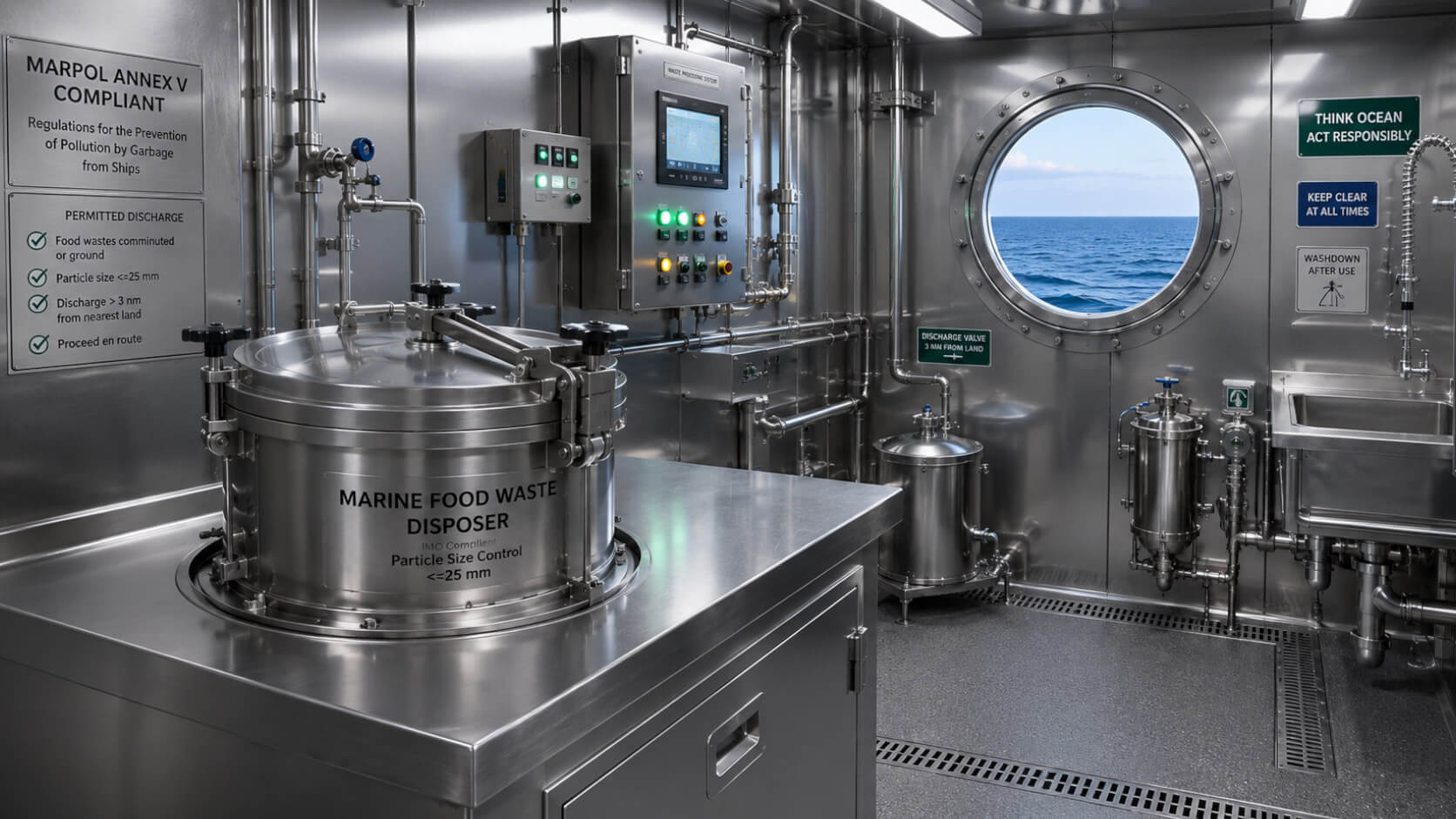
To legally discharge food waste outside restricted zones, it must be ground down to a particle size capable of passing through a screen with openings no greater than 25 millimeters. Standard residential or commercial land-based garbage disposals are not robust enough to handle the fibrous materials, bones, and high-volume throughput of a marine kitchen, nor can they guarantee this precise particle size under continuous operation.
Volume and Liquid Management
Organic waste contains high percentages of water. Modern waste management relies on dewatering systems that squeeze out excess liquids before storage or incineration. By separating the liquid fraction, vessels can reduce the total volume of stored food waste by up to 80 percent, dramatically extending the ship’s holding capacity during voyages through Prohibited Discharge Zones.
Procurement Verification Checklist for 2026
Procurement teams can no longer source disposal units based solely on horse-power and price. To safeguard the fleet against non-compliance, technical spec sheets must be rigorously verified before purchasing any marine food waste disposal system.
To assist procurement teams, the following verification matrix outlines the essential technical requirements for marine-grade deployment:
|
Engineering Parameter |
Standard Land Specification |
Required Marine Specification (2026) |
Operational Impact |
|
Material Quality |
AISI 304 Stainless or Plastic |
AISI 316L Stainless Steel |
Prevents structural failure from salt air and harsh chemical sanitizers. |
|
Particle Size Control |
Variable / Coarse |
Certified under 25 mm Grinding Screen |
Guarantees absolute compliance with the MARPOL comminution mandate. |
|
Electrical Framework |
Standard Single-Phase |
Marine Voltage (e.g., 440V / 3-Phase / 60Hz) |
Ensures seamless integration with the vessel's primary power grid. |
|
Safety Mechanisms |
Basic Splash Guard |
Magnetic Silverware Saver & Interlocked Feed |
Prevents accidental damage from cutlery and protects galley crew. |
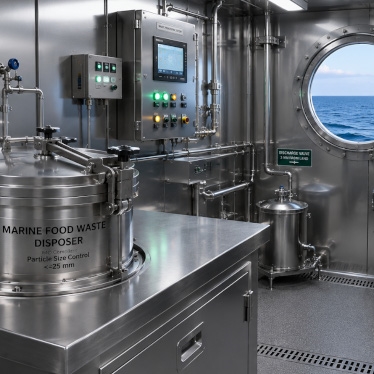
When selecting hardware, prioritizing specialized units like an approved marine food waste disposer ensures that the machinery possesses the heavy-duty grinding rings and cutting teeth necessary to meet IMO standards without jamming or wearing down prematurely.
Record-Keeping, Audits, and the Garbage Record Book
Compliance is not merely about how waste is processed; it is about how it is documented. Under MARPOL Annex V, every vessel of 400 gross tonnage (GT) and above, and every ship certified to carry 15 or more persons, must maintain an official Garbage Record Book (GRB).
-
Strict Log Entries: Every single discharge operation, whether to a port reception facility on land, an onboard incinerator, or a legal discharge at sea,must be recorded immediately. The entry must include the date, time, position of the ship, category of the garbage, and the estimated volume.
-
Receipt Retention: When discharging to shore facilities, procurement and operations teams must ensure that the receipt/certificate provided by the port reception facility is securely filed alongside the GRB. These records must be kept on board for at least two years.
-
PSC Audit Readiness: During Port State Control inspections, the GRB is one of the most heavily scrutinized documents. Any discrepancy between the volume of food waste generated on board and the volume logged as processed will trigger an immediate, deep-dive inspection of the galley and waste management spaces.
Engineering a Compliant Future At Sea
Navigating the complexities of ship waste regulations 2026 requires a proactive approach to vessel management. By moving away from reactive maintenance and investing in heavy-duty, certified AISI 316L stainless steel food waste disposers, ship operators can confidently protect their fleets from regulatory friction. Ensuring absolute MARPOL Annex V compliance safeguards the marine environment, optimizes galley ergonomics, and lowers long-term operational costs, keeping your vessels moving safely and efficiently across global waters.