Choosing between a newbuild vessel project and a major ship refit involves fundamentally different engineering approaches, particularly regarding internal outfitting. While newbuild construction allows naval architects to design utility spaces from a blank slate with unconstrained layout freedom, refits require working within the rigid physical boundaries of an existing hull structure. Understanding these operational and architectural differences enables shipowners, shipyards, and marine outfitters to optimize budgets, minimize expensive dry-dock downtime, and ensure long-term maritime compliance.
Whether outfitting an entirely new hull or comprehensively modernizing an active fleet, integrating purpose-built marine equipment remains central to operational success and crew efficiency.
Spatial Planning and Architectural Constraints
The primary divergence between newbuilds and refits lies in the degree of spatial freedom available to engineering teams during early project phases:
Newbuild Design Freedom: Naval architects build around optimized workflow logistics, setting bulkhead spacing, ceiling heights, and door clearances to perfectly match equipment dimensions. This enables ideal linear workflows in catering spaces, laundry facilities, and utility stations without structural compromises.
Refit Structural Boundaries: Refits demand working around permanent steel frames, watertight bulkheads, and non-negotiable deck cambers. Equipment must often be custom-engineered to fit existing footprints while maintaining ergonomic working clearances and meeting mandatory SOLAS escape route dimensions.
Service Routing Pathways: Newbuilds incorporate purpose-built cable raceways, dedicated piping trunks, and straight HVAC ducting runs. In refits, mechanical, electrical, and plumbing (MEP) systems must weave through existing ship infrastructure, frequently requiring specialized transitions and custom bracketry.
Installation Workflows and Timeline Dynamics
Execution methodologies differ significantly depending on whether machinery is installed in an open shipyard bay or inside an assembled, enclosed vessel hull:
Modular Pre-Outfitting in Newbuilds: Modern shipyards rely on inverted block construction, installing heavy foundations, pipe racks, and entire galley modules into open hull sections before they are welded together. This approach drastically cuts labor hours, improves weld precision, and allows parallel construction across multiple modules.
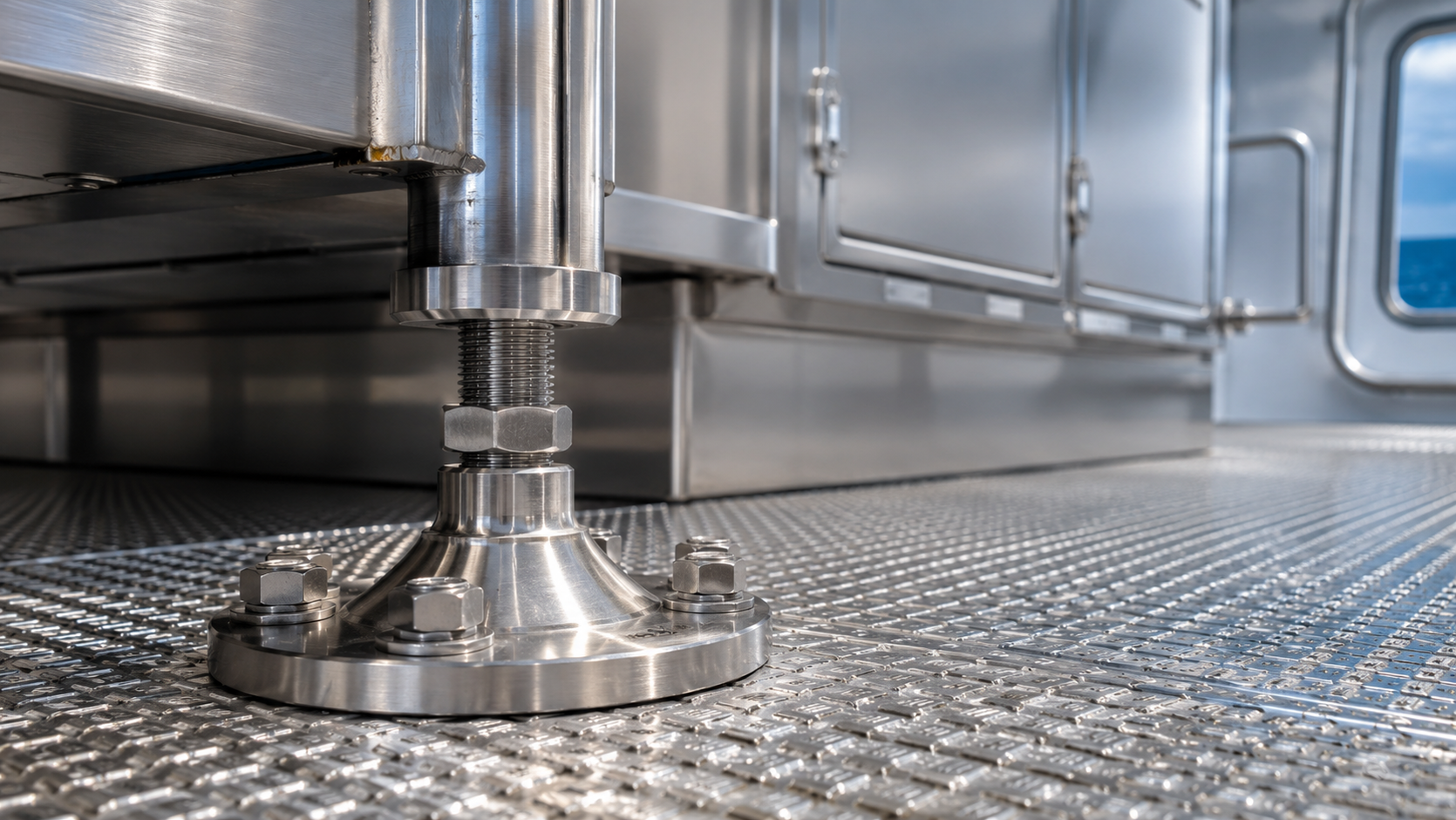
Onboard Assembly During Refits: In refit projects, all new machinery must pass through standard watertight doors, hatches, or temporary hull access cuts. Large stainless steel counters, industrial washing machines, and cooking suites must be designed as modular knock-down sub-assemblies that are transported in pieces and welded or bolted inside the compartment.
Compressed Dry-Dock Windows: Refit installations operate under extreme time pressure during scheduled dry-dock periods where every day off-hire incurs substantial financial penalties. Newbuild timelines are broader and spread systematically across the overall vessel build schedule.
Equipment Integration and System Modernization
Integrating modern utility hardware into ships requires addressing distinct electrical, mechanical, and safety challenges across both project types:
Power Grid and Automation Compatibility: Newbuild power architectures are designed around modern high-efficiency loads, smart power-sharing, and automated energy management. Refits often require adding step-down transformers, upgrading legacy distribution boards, and replacing outdated switchgear to support induction appliances and digital control systems.
Structural Remediation and Deck Preparation: Stripping out old outfitting during a refit frequently reveals hidden corrosion, degraded insulation, or uneven steel deck plates that require abrasive blasting and leveling before installation. Newbuilds provide pristine, primed decks ready for immediate welding and fastening.
Proven Engineering Benchmarks: Leading shipyards and outfitting contractors draw directly from standardized equipment specifications proven across hundreds of commercial ship and newbuild projects to guarantee immediate classification society approval and seamless commissioning.
Balancing Capital Investment and Fleet Longevity
While newbuild outfitting delivers complete design flexibility, optimized energy ratings, and seamless modular integration, a well-engineered ship refit offers a highly cost-effective method to extend a vessel's operational service life by 10 to 15 years. Successfully executing either project relies on selecting heavy-duty, AISI 316L marine-grade equipment built to handle dynamic ocean forces, whether installed into an open hull block or maneuvered into a tight refit compartment.