Managing waste on a modern vessel is a complex logistical challenge that directly impacts environmental compliance, operational costs, and crew efficiency. As international regulations, particularly MARPOL Annex V, become increasingly stringent, the maritime industry is shifting away from simple storage toward advanced, integrated marine waste management systems. Efficient waste reduction on ships is not just about disposal; it is about volume management, hygiene control, and the "invisible" movement of refuse from guest areas to processing zones.
Optimized Dry Waste Logistics: The Marine Chute Advantage
The most significant bottleneck in dry waste management is horizontal and vertical transport. Manually moving bags of refuse through service elevators and corridors is labor-intensive and compromises the luxury standard of passenger vessels.
A marine chute system for dry waste management offers a gravity-based solution that instantly relocates waste from multiple decks to a centralized handling room.
-
Seamless Flow: Inlets located on service decks allow for immediate disposal, preventing waste accumulation in pantries or corridors.
-
Fire & Safety: High-end systems utilize A-60 fire-rated doors and interlocking mechanisms to maintain vessel integrity while preventing the "chimney effect" during an emergency.
-
Material Integrity: Constructed from AISI 316L stainless steel, these chutes withstand the constant impact of waste bags while remaining resistant to the corrosive salt air that permeates vertical shafts.
Food Waste Management: Efficiency and Hygiene
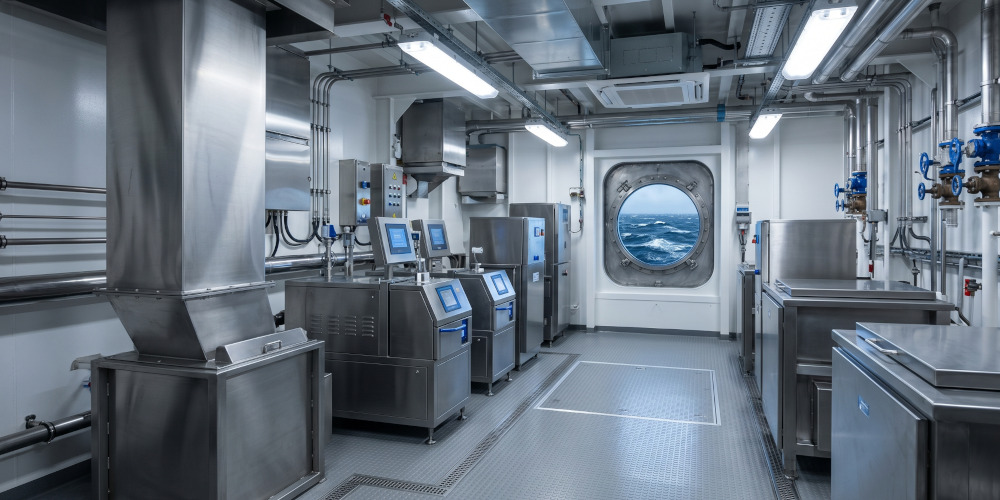
Food waste is one of the most difficult waste streams to manage due to its weight, high moisture content, and rapid decomposition. Effective food waste management on cruise ships relies on immediate processing to maintain 5-star hygiene standards.
-
Maceration and Pumping: Grinding food waste into small particles allows it to be transported via vacuum or gravity pipes to centralized holding tanks, eliminating the need for manual bag handling in the galley.
-
Dewatering and Drying: By removing the water content from macerated waste, ships can reduce the total volume of food waste by up to 80%. This dry output is easier to store and significantly cheaper to offload at port.
-
Strict Hygiene: Utilizing non-porous stainless steel surfaces in all food waste processing zones prevents bacterial growth and odor seepage, which is critical for maintaining air quality in high-traffic kitchen areas.
Volume Control: Compaction and Shredding
Once waste reaches the centralized handling room, the goal shifts to "volume reduction." The less space waste occupies, the longer a vessel can operate between port calls.
-
Heavy-Duty Compactors: Industrial-grade compactors reduce the volume of cardboard, paper, and general plastic waste. When baled and wrapped, this waste is stabilized for long-term storage in temperature-controlled rooms.
-
Glass Shredders: Glass bottles occupy significant volume. Crushing glass into small cullets not only saves space but also prepares the material for 100% recycling once the vessel reaches land.
-
Material Selection (316L): Because waste processing involves liquids and abrasive materials, all compaction and shredding hardware must be built with marine-grade stainless steel to prevent structural failure due to rust.
Digital Monitoring and the "Wildcard" Strategy
A modern approach to efficiency includes digital tracking. By monitoring waste levels in real-time, Chief Engineers can optimize the timing of compaction cycles, saving energy and reducing the mechanical wear on equipment. Furthermore, exploring waste-to-energy concepts—where certain waste streams are incinerated to provide auxiliary heat—represents the next frontier in maritime sustainability.
A Holistic Approach to Shipboard Sustainability
Efficient ship waste management is achieved when technology, material science, and crew logistics work in harmony. By investing in AISI 316L stainless steel chute systems and high-efficiency food waste processors, maritime operators protect the environment while simultaneously lowering their OPEX. A clean, efficient, and invisible waste management strategy is the hallmark of a world-class vessel that prioritizes both planet and performance.