The engineering of smart yacht galley layouts for vessels with restricted internal dimensions requires a sophisticated integration of ergonomic workflow analysis and high-density equipment selection to ensure that the primary culinary functions remain fully operational while the vessel is subjected to the dynamic forces of the open sea. Designers must prioritize the physical intersection of structural bulkheads and technical appliance footprints to maximize every cubic centimeter of available space within the hull’s unique curvature. This technical synergy between marine architecture and industrial utility facilitates a professional environment that supports high-output meal service despite the physical boundaries of the yacht interior layout. Efficient spatial management remains the most critical factor for successful yacht project completion. Designers utilize 3D modeling to verify clearances. Professional marine galley systems provide the foundation for these compact environments.
Spatial optimization involves the use of multi-functional hardware. Engineers calculate the thermal load of every appliance. This prevents the accumulation of ambient heat in narrow corridors. Yacht builders prefer materials that offer high durability and low maintenance. AISI 316L stainless steel is the industry standard for these surfaces. It resists the corrosive effects of salt air. Strategic layout planning improves the safety of the crew. It also enhances the overall resale value of the vessel.
Interior Volume Constraints on Yachts
Managing the inherent interior volume constraints on modern yachts involves a rigorous assessment of the hull’s transverse and longitudinal stability parameters which dictate the placement of heavy industrial components to maintain a low center of gravity while simultaneously providing a functional work area that complies with international maritime safety standards. The shape of the hull often creates irregular voids that standard off-the-shelf equipment cannot utilize effectively. Compact yacht kitchens require custom frames to secure hardware against pitching and rolling motions. Space is a finite resource in any maritime project. Every design choice must serve a dual purpose to justify its footprint. Yacht interior layout logic focuses on reducing wasted steps for the operator.
Deck heights restrict the installation of large ventilation hoods. Bulkheads limit horizontal movement. Engineers focus on vertical storage solutions to overcome these constraints. Lightweight composite supports provide strength without adding weight. Ventilation ducts are integrated into the cabinetry. This approach saves space without compromising structural integrity.
Layout Strategies for Functional Galleys
The implementation of layout strategies for functional galleys relies on the mathematical compression of the traditional work triangle into a high-efficiency zone where the chef can access cold storage, thermal processing, and sanitation stations without needing more than a single lateral step during the peak of the service cycle. This "One-Step" principle is the core of smart yacht galley layouts. It minimizes transit time for the crew. It also reduces the risk of accidents in rough weather. Linear layouts work best for very narrow beams. U-shaped designs provide more counter space for preparation.
U-shaped layouts create a secure workspace. The chef receives support from three sides during rolling motions. Dead zones in corners are utilized with rotating shelf systems. Sinks are typically mounted under the counter. This provides more flat surface area for preparation. Foldable counter extensions create extra space when needed. Drawer-type locking systems keep items secure. Every centimeter serves a functional purpose.
Equipment Integration in Confined Spaces
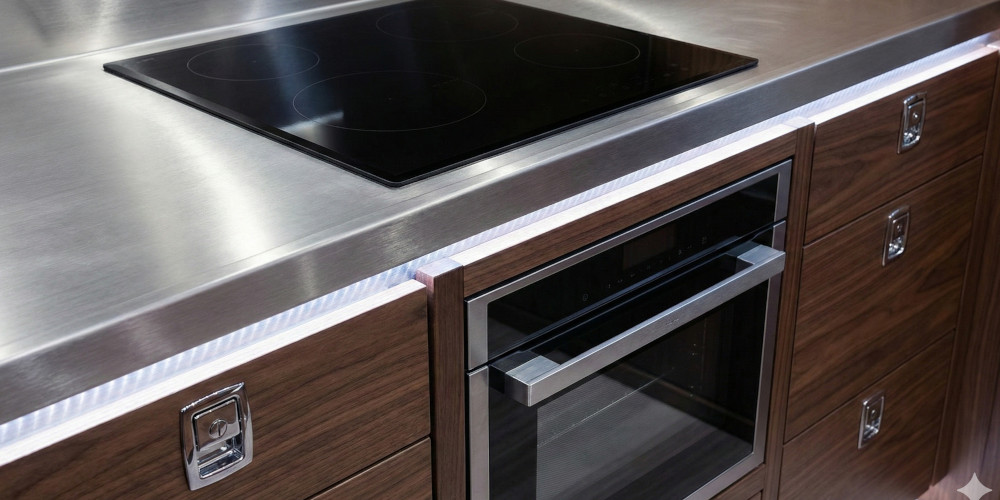
Developing a seamless system for equipment integration in confined spaces necessitates the use of advanced yacht equipment solutions that feature front-facing service access to eliminate the need for extra clearance behind the appliances which would otherwise consume valuable internal volume. Induction cooktops are the preferred choice for compact yacht kitchens. They do not require gas piping. They also produce less stray heat. This reduces the energy load on the HVAC system. Integrated appliances are built directly into the cabinetry to save room.
Combi-ovens combine multiple functions into a single unit. This reduces the total appliance count in the kitchen. Drawer-type refrigerators make under-counter areas efficient. Dishwashers are fitted with marine-grade baskets. These baskets prevent dishes from breaking during vibrations. Modular units shorten installation time at the shipyard. Parts are accessible from the front for maintenance. This prevents the dismantling of cabinets for repairs.
Table 1: Comparison of Standard vs. Smart Yacht Galley Layouts
|
Feature |
Standard Yacht Kitchen |
Smart Yacht Galley Layout |
|
Space Utilization |
Fixed units / Dead zones |
Modular / Zero-gap integration |
|
Appliances |
Standalone units |
Multi-functional / Integrated |
|
Workflow |
Traditional triangle |
Compressed "One-Step" reach |
|
Safety |
Standard latches |
Marine-grade positive locking |
|
Maintenance |
Rear access required |
Front-serviceable modules |
|
Material |
AISI 304 or Wood |
AISI 316L Stainless Steel |
|
Thermal Load |
High (Gas/Traditional) |
Low (Induction/High Insulation) |
Operational Efficiency Outcomes
The adoption of smart yacht galley layouts produces a direct improvement in operational efficiency by reducing the freshwater consumption of the vessel through high-pressure plumbing fixtures and optimizing the power distribution network to prevent peak-load surges during high-intensity culinary operations. Efficient layouts lower the stress on the crew. Meals are prepared faster. Cleaning becomes a simpler task. Non-porous stainless steel surfaces prevent bacterial growth. This ensures high hygiene standards in damp environments.
Maintenance costs decrease in the long term. Quality equipment has fewer failures. Energy savings extend the life of the generator. Quiet fans increase interior comfort. Compact kitchens provide more living space in the rest of the vessel. bu durum (this situation) increases the market value of the yacht. Professional maritime solutions transform limited volumes into high-performance areas. The balance between engineering and design makes life at sea easier.