When maritime emergencies occur hundreds of nautical miles from land, immediate helicopter medevac or shoreside triage is rarely guaranteed. Adverse weather, heavy sea states, and operational distances require ocean-going vessels to maintain self-sufficient healthcare capabilities. A ship hospital also designated as a ship’s medical center or marine infirmary serves as an autonomous clinical sanctuary engineered to stabilize trauma, isolate contagious disease, conduct minor surgical procedures, and deliver round-the-clock intensive care in rolling seas.
Far from being a standard cabin stocked with first-aid kits, an onboard medical facility is a purpose-built environment governed by strict maritime regulatory codes, specialized naval architecture, and marine-grade clinical engineering.
Regulatory Framework and Functional Layout
International maritime conventions mandate the presence and scale of medical spaces aboard commercial fleets. Under the Maritime Labour Convention (MLC 2006), vessels carrying fifteen or more seafarers on voyages exceeding three days must provide a dedicated ship hospital. For passenger vessels and naval support platforms, the World Health Organization (WHO) International Medical Guide for Ships and the International Maritime Organization (IMO) outline stringent requirements for compartmentalization:
- Location and Vibration Mitigation: Ship hospitals are situated near the vessel's center of buoyancy typically amidships on lower accommodation decks where pitch and roll accelerations are minimized. This deliberate positioning stabilizes patients suffering from spinal injuries, fractures, or shock during heavy weather.
- Aseptic Zoning: Facilities are segmented into distinct operational zones: an outpatient consultation desk, an acute examination and minor surgery suite, a sterilization and decontamination station, and dedicated patient ward berths.
- Airborne Isolation Infrastructure: Contemporary vessel hospitals integrate negative-pressure isolation wards equipped with independent HEPA filtration systems. This prevents the spread of respiratory pathogens into crew accommodation blocks, discharging exhausted air directly overboard via dedicated ductwork.
Marine-Grade Medical Outfitting and Sea-Fastening
Standard land-based hospital equipment is unsuited to the dynamic motions of an ocean voyage. Medical outfitting at sea requires mechanical reinforcements to secure sensitive apparatus against pitch, roll, and structural vibration:
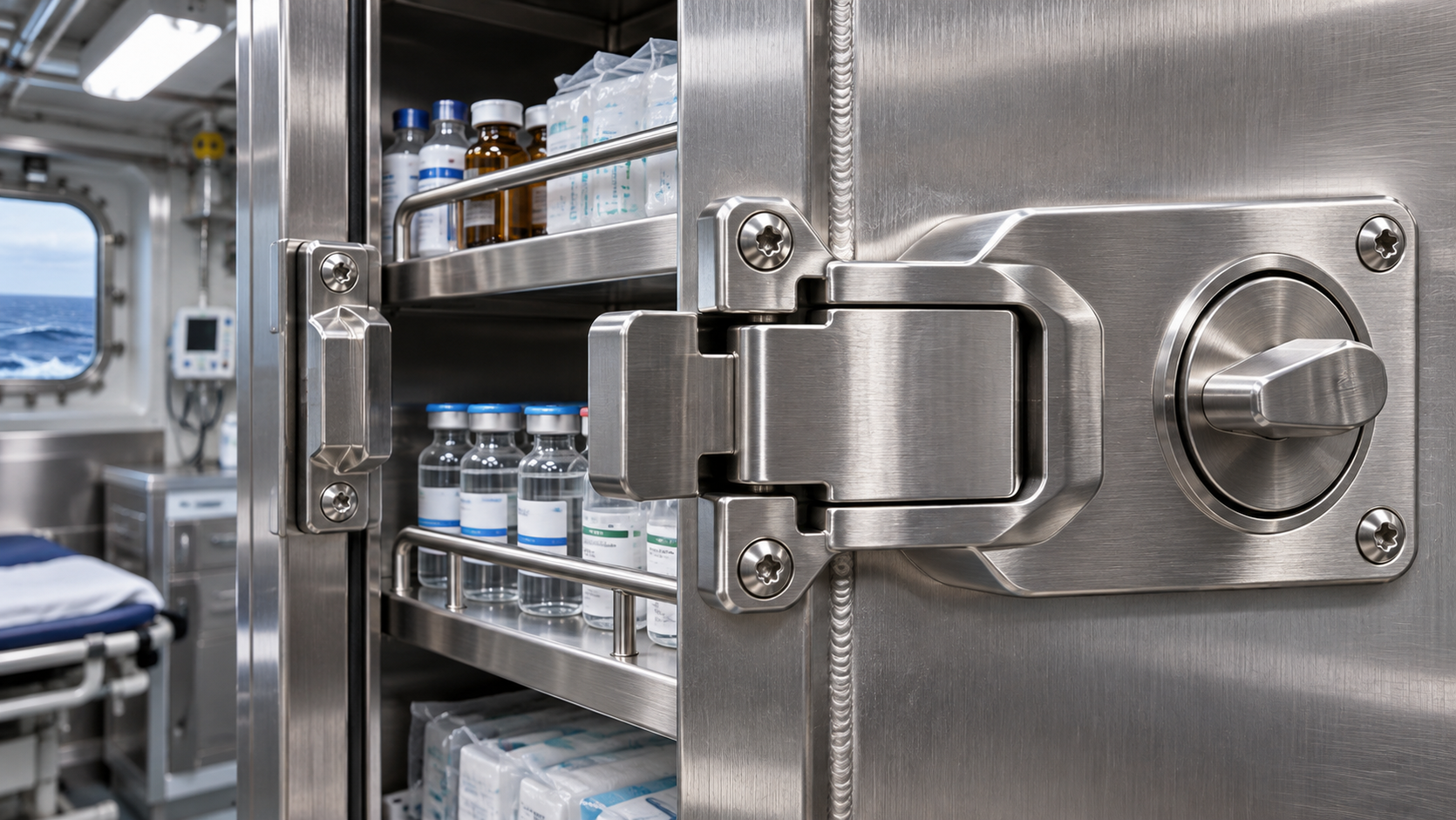
- Positive-Lock Medical Cabinetry: All medicine storage lockers, narcotic vaults, and surgical supply units feature marine turn-latches, double-cam locks, and internal shelf retaining lips. This mechanical retention ensures ampoules, glass vials, and sterile instrument packs do not tumble during abrupt vessel maneuvers.
- Bulkhead-Anchored Examination Platforms: Treatment tables and patient beds are engineered from heavy-gauge austenitic stainless steel securely bolted through deckhead and deck plates. Beds are fitted with integrated padded storm side rails, patient restraint straps, and multi-point gimballed tilt locks to secure patients during severe listing.
- Overhead Equipment Retention: Surgical task lights, defibrillator mounts, and vital sign monitors mount onto reinforced ceiling tracks and articulating arms equipped with positive mechanical friction stops, eliminating swinging hazards.
Metallurgy and Clinical Sanitation in Maritime Environments
Infirmary spaces require continuous chemical sanitation using halogenated biocides, chlorhexidine scrubs, and iodine compounds. Combined with high ambient ocean humidity, standard commercial materials quickly deteriorate:
- AISI 316L Stainless Steel Construction: Work surfaces, wash stations, instrument prep counters, and decontamination sinks rely on molybdenum-fortified AISI 316L stainless steel. Its heightened resistance against pitting corrosion and crevice attack ensures zero structural breakdown under repeated exposure to medical disinfectants and saline air.
- Seamless Sanitary Detailing: Countertops, backsplashes, and surgical scrub stations feature fully welded, radiused coved internal corners. Eliminating microscopic crevice joints prevents organic fluid entrapment, halting bacterial biofilms from proliferating in isolated healthcare compartments.
- Hands-Free Sanitary Control: Washpoints utilize mechanical knee-paddle controls or sealed infrared sensors with laminar flow straighteners, stopping aerosol pathogen dispersion while maintaining water conservation at sea.
Medical Gas Networks and Technical Infrastructure
To support trauma and surgical stabilization, ship hospitals house robust internal technical support utilities:
- Dedicated Medical Oxygen Stations: Cylinders are secured in external, blast-relieved lockers and piped directly into treatment bulkheads through brass or copper medical-grade lines. Delivery outlets in the examination suite feature color-coded quick-connect valves with integrated line pressure monitoring.
- Emergency Power Resiliency: All life-support systems, suction pumps, and critical monitoring arrays connect directly to the ship’s uninterruptible power supply (UPS) and emergency switchboard, guaranteeing uninterrupted operation during main engine cutouts or generator blackouts.
- Telemetry and Telemedical Integration: Modern ship hospitals feature satellite telemedical uplinks, routing live patient ECG, ultrasound feeds, and high-definition diagnostic imaging directly to shoreside trauma centers for real-time remote physician oversight.
Upholding Crew Welfare Across Global Oceans
A well-engineered ship hospital bridges the vast gap between an offshore emergency and definitive shoreside medical intervention. By integrating robust marine-grade AISI 316L metallurgy, positive sea-fastening hardware, certified isolation zones, and reliable medical gas delivery, vessel operators protect their greatest asset, the crew ensuring clinical care remains uncompromising anywhere on the globe.