Marine refrigeration systems play an indispensable role in safeguarding crew welfare and preserving provision stores across extended ocean passages. Traditionally, shipboard cooling infrastructure relied heavily on high-Global Warming Potential (GWP) hydrofluorocarbons (HFCs) like R-404A and R-134a. However, tightening environmental regulations driven by the Kigali Amendment to the Montreal Protocol, revised EU F-gas rules, and the International Maritime Organization’s (IMO) decarbonization targets are accelerating a mandatory transition toward low-GWP alternatives.
Navigating this shift requires marine technical superintendents and vessel designers to balance thermodynamic efficiency, onboard safety classifications, and long-term chemical availability in harsh offshore environments.
The Push Away from Legacy High-GWP Working Fluids
A refrigerant's Global Warming Potential measures its relative heat-trapping impact in the atmosphere compared to carbon dioxide. Conventional marine cooling plants historically operated on chemical blends with substantial environmental footprints:
- R-404A: Once the standard for low-temperature provision freezers, it is now widely banned for new installations across major maritime jurisdictions due to its severe climate impact.
- R-407 Blends: Initially used as interim transition options, these chemical mixtures are facing escalating production quotas and supply shortages worldwide.
- R-134a: Common in medium-temperature food storage and chillers, it is subject to progressive phase-down caps that will make refills increasingly scarce and costly at global ports.
Under heavy sea conditions, constant vessel vibration and thermal cycling frequently elevate annual refrigerant leakage rates beyond land-based commercial averages. When high-GWP gases escape, they significantly expand a vessel's indirect carbon footprint, directly complicating compliance with Carbon Intensity Indicator (CII) targets.
Low-GWP Alternatives for Modern Marine Cold Chains
Transitioning to sustainable working fluids involves evaluating modern synthetic alternatives and natural refrigerants against strict naval safety codes.
1. Hydrofluoroolefins (HFOs) and Transition Blends
Modern synthetic molecules like R-1234ze and intermediate lower-GWP blends offer cooling performance comparable to traditional gases without requiring a total redesign of compressor plants. They serve as practical bridge solutions for vessel retrofits, allowing operators to significantly lower their environmental profile while utilizing familiar system architectures.
2. Carbon Dioxide Systems
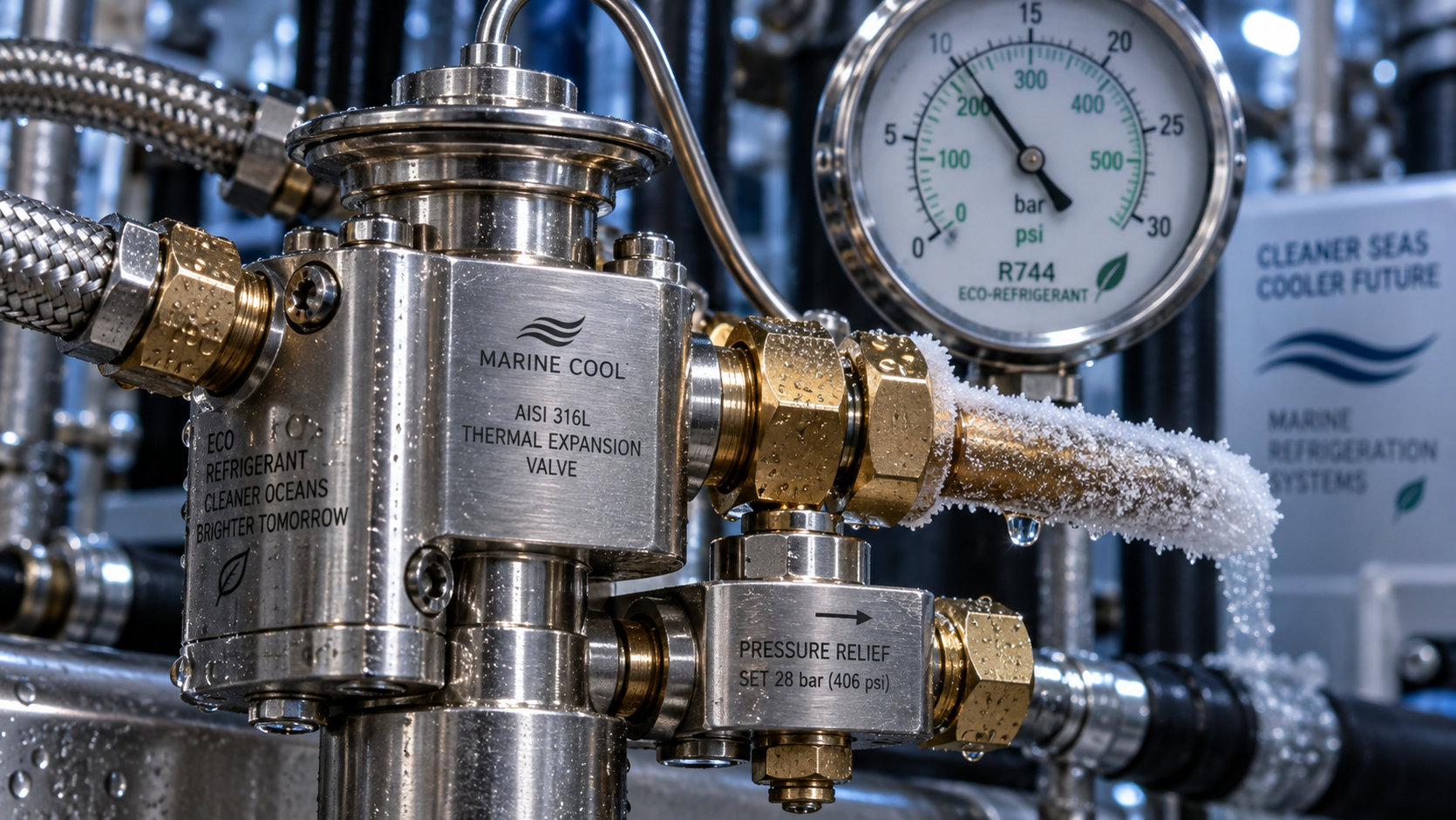
Carbon dioxide stands out as a permanent natural solution for central shipboard provision plants. It is non-flammable, non-toxic, and has zero ozone-depleting potential. Although Carbon Dioxide systems run at considerably higher operating pressures than conventional setups, modern marine-grade piping metallurgy, reinforced safety valving, and automated controls make it an increasingly popular choice for commercial newbuilds.
3. Hydrocarbons (Propane and Isobutane)
Hydrocarbons provide exceptional thermodynamic efficiency with negligible environmental impact, making them well-suited for modular, plug-in galley units. Because maritime fire-prevention codes restrict flammable gases in shared spaces, these systems are strictly limited to factory-sealed, low-charge circuits such as stand-alone reach-in refrigerators rather than centralized machinery rooms.
Operational Integration and Vessel Galley Layouts
Adopting eco-friendly cooling loops requires deliberate coordination between refrigeration machinery and spatial galley planning:
- Ventilation and Gas Detection: Transitioning to modern refrigerants requires automated leak sensors, integrated audiovisual alarms, and dedicated exhaust ducting within compressor compartments.
- Decoupled Modular Architecture: Central provision rooms can be effectively supported by autonomous, hermetically sealed marine coolers placed directly inside food prep lines. This strategy reduces the total volume of piped gas running through living quarters and service alleys.
- Unbroken Cold-Chain Reliability: Maintaining stable temperatures across meat freezers, vegetable storage, and dairy rooms requires integrated thermal planning, as detailed in our guide to cold storage planning for yacht and ship galley design.
Securing Compliance and Cooling Reliability
Transitioning to low-GWP refrigerants is an operational priority to protect fleets from regulatory penalties and prevent costly supply bottlenecks in port. By combining eco-friendly working fluids with heavy-duty, vibration-resistant marine stainless steel cabinetry, shipowners can achieve verifiable environmental compliance without sacrificing cold-chain integrity in open waters.