Washing dishware and cookware at sea presents distinct operational challenges that terrestrial commercial kitchens never encounter. Vessel pitch and roll, limited freshwater storage, fluctuating electrical supply, and confined compartment footprints require dishwashing equipment engineered specifically for maritime conditions. Operating the wrong unit leads to excessive utility consumption, high sanitization failure rates, and crew bottlenecks. Selecting the appropriate industrial dishwasher ensures seamless daily service while maintaining compliance with international marine health guidelines.
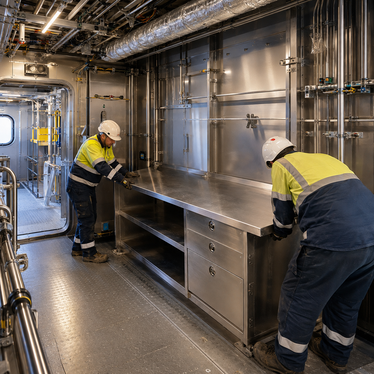
A well-planned marine scullery balances throughput capacity, mechanical footprint, and water consumption across the primary equipment categories.
Primary Types of Marine Dishwashers
Different vessel classes—ranging from offshore tugs and container vessels to large cruise liners and naval ships—require tailored dishwashing equipment based on meal counts and available space.
Undercounter Dishwashers
Undercounter units are compact, self-contained machines designed for small-to-midsize crews (up to 30–40 persons) or dedicated officer messes, crew pantries, and bars.
- Capacity: Typically processes 20 to 30 racks per hour.
- Key Advantage: Fits directly below standard 900 mm stainless steel countertops, preserving valuable deck and bulkhead area in constrained layouts.
- Operational Fit: Workboats, specialized offshore support vessels (OSVs), coastal vessels, and satellite shipboard pantries.
Hood-Type (Pass-Through) Dishwashers
Hood-type machines feature an openable hood designed for linear or corner workflows between dirty-dish sorting tables and clean landing counters.
- Capacity: Processes 50 to 80 racks per hour, supporting crews between 40 and 150 persons.
- Key Advantage: Ergonomic sliding operation eliminates continuous bending, speeding up scullery cycles during short turnarounds between watches.
- Operational Fit: Bulk carriers, oil tankers, container ships, and offshore platform main galleys.
Utensil and Pot Washers (Granule/High-Pressure)
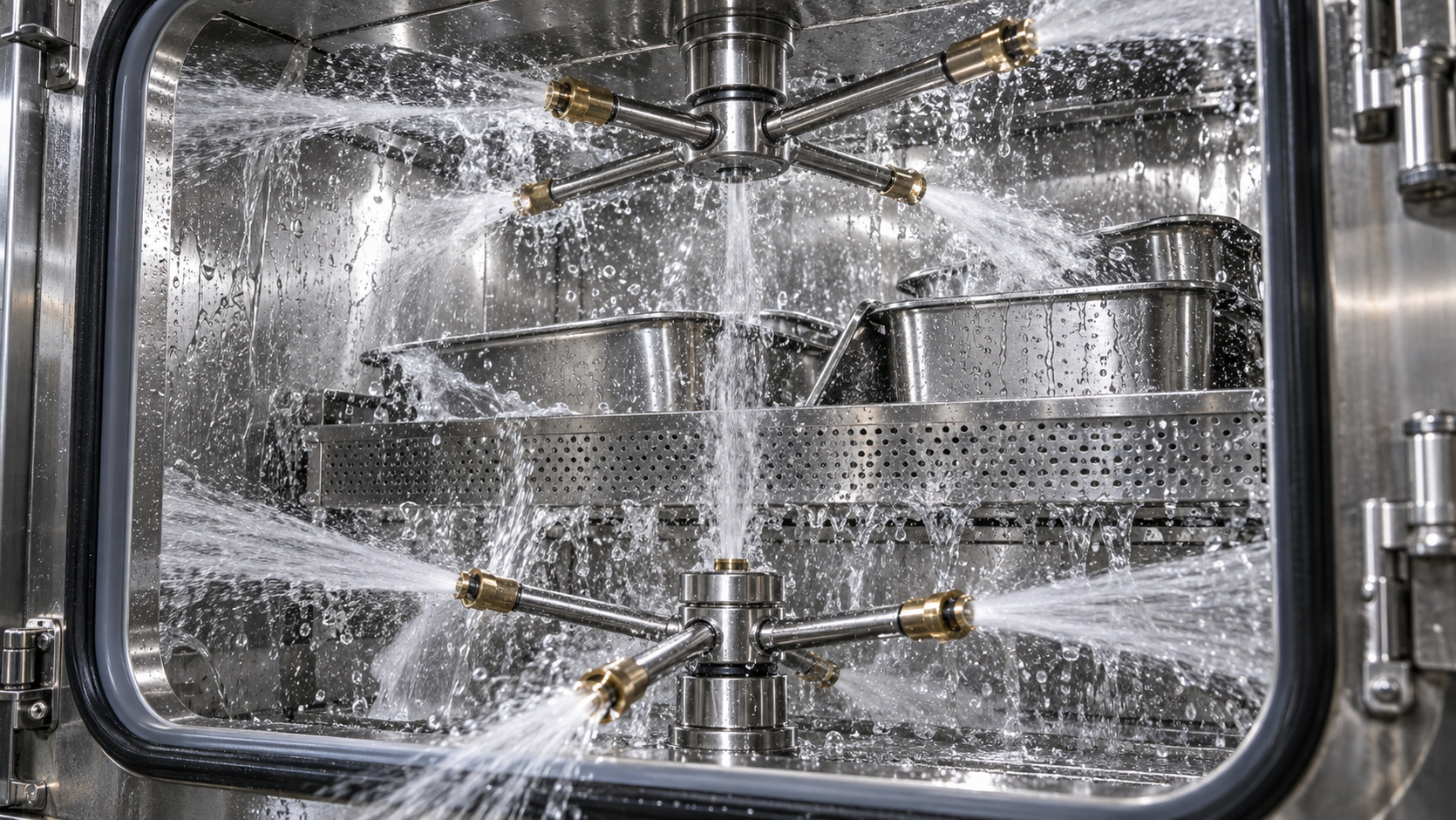
Standard dishwashers lack the physical chamber volume and pump pressure required to remove baked-on grease from large gastro-norm containers, stock pots, and sheet pans.
- Capacity: Built with wide wash chambers and high-pressure spray arms, often incorporating oscillating wash cycles or sanitizing wash pressures exceeding 1.5 bar.
- Key Advantage: Reduces manual scrub time and slashes hot water consumption in central production galleys.
- Operational Fit: High-capacity production kitchens on commercial vessels, expedition ships, and offshore accommodations.
Rack Conveyor and Flight-Type Washers
Continuous-feed systems automate large-scale dishwashing by conveying racks or individual plates through segregated pre-wash, wash, rinse, and drying zones.
- Capacity: Capable of processing 100 to over 250 racks per hour.
- Key Advantage: Delivers massive hourly throughput with computerized heat-recovery systems that capture steam to pre-heat incoming cold rinse water.
- Operational Fit: Commercial cruise vessels, large passenger ferries, and naval accommodation platforms.
Critical Selection Criteria for Marine Operations
Evaluating dishwashing hardware for a shipboard installation requires looking beyond nominal plate counts to maritime-specific engineering constraints.
- Freshwater Conservation: Producing potable water via reverse osmosis evaporators draws significant engine heat or auxiliary electric power. Modern marine dishwashers minimize fresh water usage to 2.0–2.4 liters per rack using multi-stage wash-tank filtering and optimized final-rinse spray patterns.
- Structural and Motion Resilience: Standard commercial units leak or spill wash water during heavy seas. Marine-certified units incorporate anti-spill internal wash tank baffles, positive mechanical door latches, and vibration-damped pump mounts.
- Sanitization Compliance: International vessel sanitation protocols mandate high-temperature thermal sanitizing to guarantee pathogen destruction. Equipment must feature high-output atmospheric booster heaters that operate reliably within maritime electrical feeds (400V–440V / 3-phase / 50–60 Hz).
- HACCP Workflow Integration: Selecting verified scullery equipment built from satin-brushed AISI 304 or AISI 316L stainless steel prevents cross-contamination between soiled return zones and clean staging areas, supporting strict compliance with food safety on ships, HACCP guidelines, and galley design.
Matching Dishwasher Engineering to Fleet Demands
Specifying the correct marine dishwasher requires aligning vessel crew numbers and peak dining turnarounds with water conservation capabilities and rugged structural construction. Whether installing an undercounter washer in an offshore tug or a high-capacity pass-through system on an ocean-going merchant ship, selecting purpose-built marine equipment ensures continuous operational uptime, lower utility costs, and uncompromised hygiene at sea.