In the maritime industry, material selection directly dictates a vessel's operational lifespan, maintenance budgets, and crew safety. The open ocean environment is a destructive arena for metals due to high salt concentrations, constant humidity, and aggressive chloride ions. The frequently encountered question of "304 or 316L?" is far more than a simple strength preference—it is a material science necessity. From ship galleys to above-deck hardware, 316L stainless steel is recognized as the definitive marine standard.
Material Science Comparison: 304 vs 316L
While both steel types belong to the austenitic stainless steel family, their alloy elements at the atomic level differentiate them in chloride-heavy environments.
-
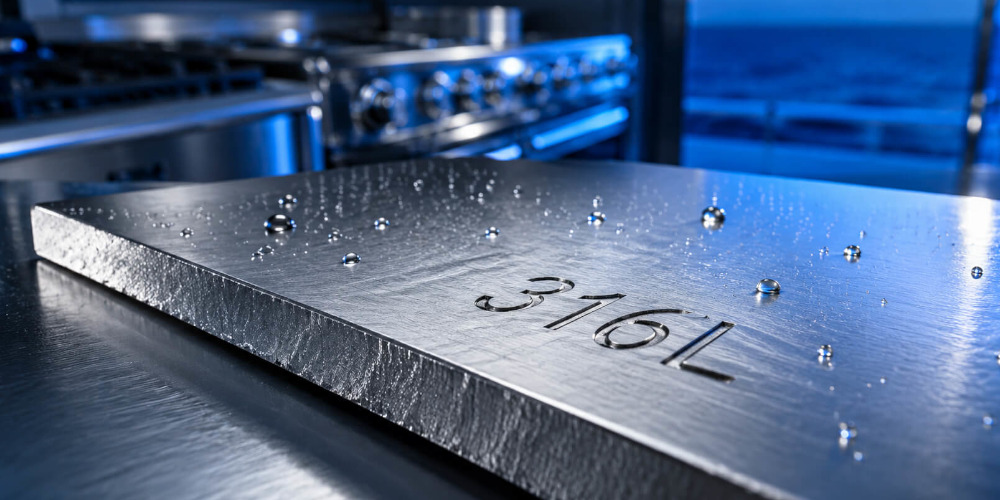
The Molybdenum Difference: The most critical parameter separating 316L stainless steel from 304 is the addition of 2 to 3 percent Molybdenum in its structure. Molybdenum protects the protective chromium-oxide passivation layer on the steel surface against the aggressive microscopic attacks of chloride ions.
-
The "L" Designation and Intergranular Corrosion: The letter "L" in 316L stands for Low Carbon (0.03 percent and below). During welding processes, steel exposed to high heat can experience chromium carbide precipitation. When the carbon ratio is kept low, the loss of chromium element at the grain boundaries is prevented, eliminating the risk of intergranular corrosion in weld zones.
-
Pitting Resistance Equivalent Number (PREN): In the PREN formula used to calculate a material's resistance to pitting corrosion, specific coefficients of Molybdenum and Nitrogen percentages are added to the Chromium ratio. According to this calculation, while the value of 304 steel is around 18-20, the value of 316L steel rises to the 23-25 band. This variance means the pitting resistance multiplies exponentially in seawater.
Chemical and Physical Metallurgy Comparison
The following table summarizes the key differences that determine material selection criteria in industrial marine applications:
|
Alloy Property |
AISI 304 ( Standard Industrial ) |
AISI 316L ( Marine Grade ) |
Importance for Maritime Operations |
|
Chromium |
18.0 - 20.0 percent |
16.0 - 18.0 percent |
Provides core corrosion resistance and forms the passivation layer. |
|
Nickel |
8.0 - 10.5 percent |
10.0 - 14.0 percent |
Maintains the austenitic structure, offering flexibility and toughness. |
|
Molybdenum |
Not present (0 percent) |
2.0 - 3.0 percent |
Prevents chloride and saltwater pitting corrosion. |
|
Carbon |
0.08 percent and below |
0.03 percent and below (Low Carbon) |
Prevents post-weld cracking and intergranular corrosion. |
|
PREN Value |
18 - 20 |
23 - 25 |
Numerical evidence of superior pitting corrosion resistance. |
|
Salt Spray Test |
Rusts rapidly under continuous chloride |
Excellent durability with zero corrosion |
Highest resistance duration during atmospheric salt exposure. |
Laboratory Testing and Certification Requirements
In the maritime sector, a material's success is established through internationally accredited laboratory tests and IMO (International Maritime Organization) compliant certifications rather than theoretical formulas.
ASTM B117 Salt Spray Test Results
In standardized, accelerated corrosion testing (Salt Spray Test), AISI 304 surfaces subjected to a 5 percent sodium chloride solution begin to show "tear corrosion" and rust spots within the first 100 to 200 hours. In contrast, marine-grade 316L stainless steel preserves its surface integrity and suffers no structural degradation even past 1000 hours of continuous exposure, thanks to its molybdenum shield.
NSF (National Sanitation Foundation) and Food Safety
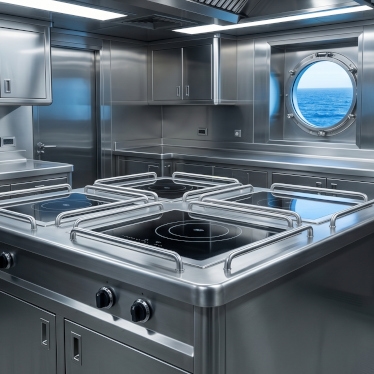
Particularly when galley cookware equipment is concerned, a material's resistance to corrosion translates directly to food hygiene. According to NSF/ANSI Standard 2 (Food Equipment) requirements, food contact surfaces must be non-porous and capable of handling aggressive cleaning chemicals. The smooth microstructure of 316L prevents bacterial biofilm formation and remains unaffected by harsh marine cleaners.
Long-Term Life Cycle Costing (LCC) Analysis
While AISI 304 may appear to be a more economical alternative during the purchasing phase, the reality reverses when analyzing the ship's Life Cycle Costing.
-
Duruş Süresi (Downtime) Costs: The failure of a galley unit or pipeline due to saltwater corrosion mid-ocean can lead to ship downtime (off-hire) due to the logistical difficulties of the offshore spare parts supply chain.
-
Replacement and Labor: Equipment manufactured from 304 steel often completes its structural lifespan within 3 to 5 years in a marine setting. Conversely, 316L constructions provide trouble-free service across the entire operational lifespan of the vessel (20-25 years) with correct preventative maintenance.
-
Return on Investment (ROI): The marginal price difference paid for 316L during initial investment amortizes itself within the first 2 years through zero maintenance requirements and zero component replacements.
The Correct Choice in Marine Stainless Steel
There is no room for error on the open seas. Utilizing 316L as the definitive marine stainless steel standard against stress corrosion cracking and localized pitting caused by chloride ions is indispensable for engineering sustainability. Fully compliant with IMO and NSF regulations, accredited 316L stainless steel infrastructures provide shipowners with effortless regulatory audits while eliminating operational risks to guarantee a safe voyage.